
1. Materials for Solar Panel Mounting Structures
Material selection is the foundation of solar mounting structure performance. Mounting structures must withstand 20-30 year outdoor exposure while supporting PV panels against wind loads, seismic forces, and thermal cycling. The three dominant materials each serve specific applications.
Aluminum Alloys (Dominant Choice)
Aluminum alloys dominate residential and commercial rooftop solar installations due to their lightweight-to-strength ratio, natural corrosion resistance, and ease of fabrication. Two grades are standard:
- 6005-T6: Main structural extrusions, rails, and profiles. Tensile strength of 260 MPa, yield strength of 240 MPa. Ideal for main structural members due to excellent load-bearing capacity.
- 6060-T6: Clamps, brackets, and accessories. Lower strength but better extrusion fluidity, producing smoother surfaces for visible installation components.
Aluminum's density of 2.7 g/cm³ (approximately 2.5× lighter than steel) significantly reduces rooftop load and simplifies ground-mount installation logistics. The natural aluminum oxide layer (Al₂O₃) provides excellent corrosion resistance without additional coating in most environments.
Galvanized Steel (Ground-Mount & Utility-Scale)
Hot-dip galvanized steel (Z275 = 275 g/m² zinc coating) remains the material of choice for ground-mount solar structures and utility-scale projects where weight is less critical but cost efficiency and structural strength are paramount. Common specifications include:
- S350GD+Z275 (yield strength 350 MPa, EN 10346 standard)
- S420GD+Z275 (yield strength 420 MPa, for heavy-load structures)
- Thickness range: 1.5mm to 6.0mm depending on structural requirements
Stainless Steel (Fasteners & Coastal Applications)
A2 (AISI 304) and A4 (AISI 316) stainless steel are reserved for fasteners, bolted connections, and mounting structures in coastal or high-humidity environments. A4 (316) with 2-3% molybdenum provides superior pitting resistance against salt air.
2. Press Brake Bending for Solar Mounting Brackets
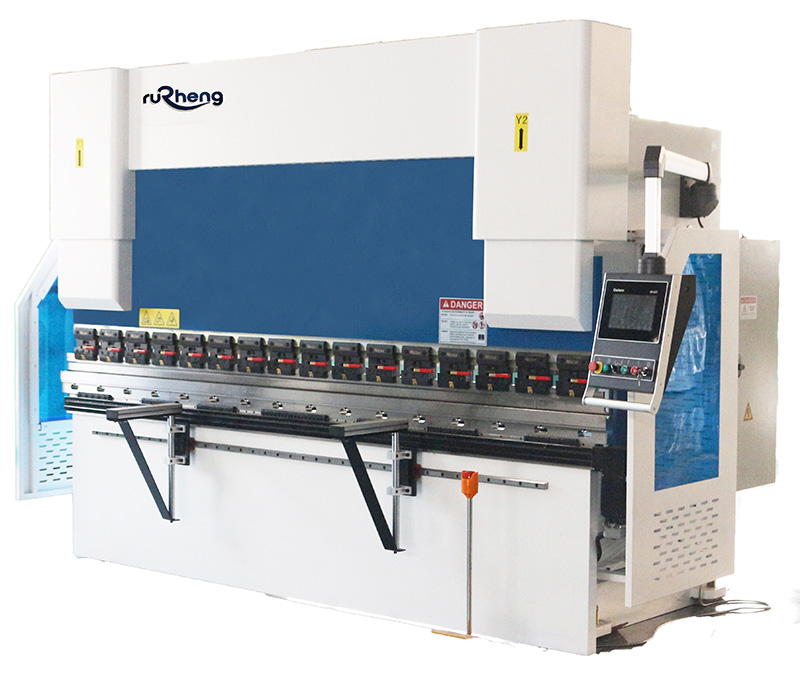
The press brake is the most critical machine in solar mounting bracket fabrication. CNC press brakes with servo-electric or electro-hydraulic drives provide the precision, repeatability, and flexibility needed for the diverse bracket geometries required across different PV mounting configurations: rooftop rails, ground-mount legs, and ballast frames.
V-Die Selection for Solar Structures
V-die opening width determines bending force, inside bend radius, and material springback. The standard rule: V-die width = 6-8× material thickness.
| Material Thickness | Recommended V-Die Width | Bend Type | Typical Application |
|---|---|---|---|
| 1.5mm | 10-12mm | Air bending | Thin aluminum clamps |
| 2.0mm | 16mm | Air bending | Aluminum brackets |
| 3.0mm | 20-24mm | Air / Bottoming | Heavy-duty brackets |
| 4.0mm (galv. steel) | 30-32mm | Bottoming | Ground-mount structural members |
| 5-6mm (galv. steel) | 40-50mm | Bottoming / Coining | Heavy structural profiles |
Springback Compensation for Aluminum 6005-T6
Aluminum 6005-T6 exhibits significant springback due to its high yield strength-to-modulus ratio. The springback angle typically ranges from 1° to 3° depending on the inside radius-to-thickness ratio. Accurate compensation requires:
- CNC press brake with multi-axis back gauge (R-axis for radius compensation)
- Material-specific bend deduction tables for 6005-T6
- Test bends with measurement verification before production runs
- Overbending by 1-3° for complex multi-angle brackets
CNC Crowning for Long Solar Rails
Long solar mounting rails (up to 6 meters) require press brakes with CNC crowning systems to counteract deflection under bending force. Mechanical crowning adjusts the ram profile via a tapered block, while hydraulic crowning uses proportional valve control for infinitely variable compensation across the entire bending length. Without crowning, long parts exhibit center deflection resulting in non-uniform bend angles.
3. Laser Cutting for Solar Mounting Holes and Profiles

Fiber laser cutting is essential for solar mounting structure fabrication, providing precision hole patterns, elongated slots for adjustment, and complex profiles that are impractical or impossible with punch tooling. For high-volume standard holes and slots, a CNC punching machine can reduce cost per part and keep repeated PV bracket patterns consistent. Modern fiber lasers (1-6kW) offer the precision, speed, and material versatility required for both aluminum and galvanized steel solar components.
Fiber Laser vs CO2 for Solar Structures
Fiber lasers have decisively replaced CO2 lasers for sheet metal solar fabrication. The shorter wavelength (1.06μm vs 10.6μm) is absorbed more efficiently by metals, resulting in:
- 3-5× faster cutting speeds on thin-gauge aluminum (1-3mm)
- Cleaner edges without dross on aluminum (no assist gas reaction)
- 50% lower energy consumption
- Near-zero maintenance (no gas mirror cleaning, no laser tube replacement)
- Superior cutting of highly reflective aluminum without damage to optics
Cutting Parameters for Solar Materials
Fiber laser parameter optimization is critical for cut quality. Key parameters include laser power, cutting speed, assist gas (type and pressure), and focal point position.
| Material | Thickness | Power | Speed | Assist Gas |
|---|---|---|---|---|
| Aluminum 6005-T6 | 2mm | 2kW | 15 m/min | Nitrogen (1.5 MPa) |
| Aluminum 6005-T6 | 3mm | 3kW | 8 m/min | Nitrogen (1.2 MPa) |
| Galv. Steel S350GD | 2mm | 1.5kW | 20 m/min | Oxygen (0.8 MPa) |
| Galv. Steel S350GD | 4mm | 3kW | 6 m/min | Air (1.0 MPa) |
| Stainless Steel 304 | 2mm | 2kW | 12 m/min | Nitrogen (1.0 MPa) |
4. Complete Manufacturing Process Workflow
A typical solar mounting structure fabrication line follows this integrated workflow, optimized for both efficiency and quality consistency:
- Material preparation: Decoiling and leveling of aluminum coils or galvanized steel sheets. For extruded solar rails, skip to step 3.
- Laser cutting: Cut-to-length, hole patterns, slot patterns, and complex profiles. Nested cutting maximizes sheet utilization (material utilization rate 75-85%).
- CNC punching (optional for high volume): For repetitive hole patterns on solar rails and structural members, turret punch presses offer higher throughput than laser for standard hole configurations.
- Press brake bending: Form bracket flanges, rail end forms, leg angles, and mounting plate bends. Multi-axis back gauge ensures repeatability across production batches.
- Welding and assembly: TIG/MIG welding assembles pre-formed components into sub-assemblies (e.g., ground-mount leg frames, rooftop frame kits).
- Surface treatment: Aluminum structures: anodizing or powder coating. Galvanized steel: powder coating over zinc substrate. This step is critical for 20-30 year outdoor durability.
- Quality control: Dimensional verification, torque testing of bolted connections, and visual inspection of weld quality and surface finish.
- Packaging and labeling: Component kits are bundled with hardware packs (fasteners, clips, seals) and labeled for specific project specifications.
5. Equipment Recommendations for Solar Mounting Fabrication
Selecting the right equipment configuration depends on production volume, product mix, and budget. The following table provides guidance for typical scenarios:
| Production Scale | Press Brake | Laser Cutter | Punch Press | Est. Investment |
|---|---|---|---|---|
| Startup / Small Batch | 63-100T, 2500mm, CNC servo | 1-2kW fiber, 3015 format | Optional (outsource punching) | $150,000 - $300,000 |
| Medium Volume | 160T, 3200mm, CNC crowning | 3-4kW fiber, 4020 format | 32-48 station turret | $500,000 - $1,000,000 |
| High Volume / Automated | Tandem press brake (2× 400T) | 6kW+ fiber, automated loading | High-speed CNC punch | $1,500,000+ |
6. Quality Standards for Solar Mounting Structures
Solar mounting structures must meet stringent international standards to ensure 25+ year structural reliability. Key standards include:
- EN 1993-1-1 / Eurocode 3: Design of steel structures (European market)
- AS/NZS 1170.2: Structural design actions — wind actions (Australia/New Zealand)
- IBC 2021: International Building Code with ASCE 7-22 wind load provisions (USA)
- UL 2703: Mounting systems, mounting devices, clamping/retention & grounding devices for solar modules (safety certification)
- IEC 61215: Crystalline silicon terrestrial PV module quality and safety (testing framework)
Manufacturing tolerance requirements typically specify: hole pattern positions ±0.1mm, bend angles ±0.5°, overall dimensions ±1mm per meter, and surface treatment thickness 60-80μm for powder coating.
Need a Solar Mounting Structure Manufacturing Solution?
For related setup decisions, review our press brake force calculation guide, CNC press brake programming basics, and sheet metal fabrication cost reduction guide.
Our engineering team can configure the right press brake, laser cutter, and production line for your solar mounting structure fabrication needs.
Request Press Brake Quote