
HVAC Duct Bending and Fabrication Machines: Press Brake, Shear and Forming Guide
| Your requirements | Recommended equipment | Next Rucheng page |
|---|---|---|
| HVAC duct bending | 40T-100T CNC press brake, 2500-3200 mm bed, light-gauge tooling | Press brake machine guide |
| Cutting duct blanks | Guillotine shear or swing beam shear for 0.5-1.5 mm galvanized steel | Shearing machine range |
| Repeated holes, louvers and takeoffs | CNC punching machine for volume work, fiber laser for flexible cutouts | CNC punching machine |
| Need price or FOB China proposal | Send duct size, material, thickness, bend length, hole pattern and daily output | Press brake quote form |
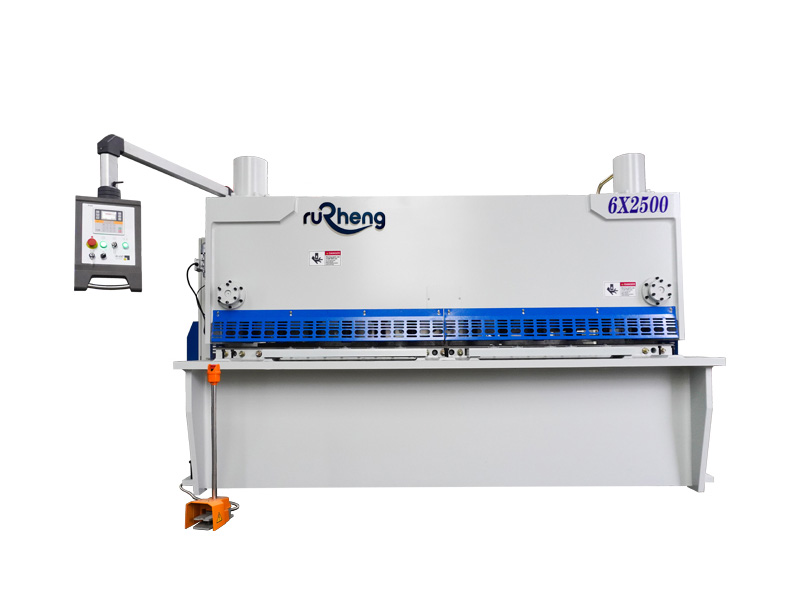
Guillotine shear — primary cutting machine for HVAC duct sheet preparation
What Is HVAC Duct Fabrication?
HVAC duct fabrication is the manufacturing process that converts flat metal sheets — typically galvanized steel, stainless steel, or aluminum — into air distribution ductwork. This includes rectangular (rectangular duct), round (spiral duct), and oval duct products used in heating, ventilation, and air conditioning systems across residential, commercial, and industrial buildings.
The duct fabrication process covers a series of operations: cutting sheet blanks to size, forming longitudinal seams (Pittsburgh lock, snap-lock, or groove joints), bending flange edges, notching corners, and assembling fittings (elbows, tees, reducers) into complete duct runs ready for installation.
Duct fabrication shops range from small custom operations producing one-off fittings to high-volume automated lines manufacturing standardized duct sections. The machines required differ significantly between these models, and selecting the right equipment depends on the duct types, material thicknesses, production volumes, and precision requirements of your target market.
The 4 Core Machine Types for Duct Fabrication
2.1 Shearing Machine — Sheet Cutting

Swing beam shear — fast, clean cuts on duct sheets up to 3 mm thickness
Shearing machines are the first stage of duct fabrication, cutting large sheet coils or plates into blank sizes ready for forming. In HVAC duct production, the two primary shear types are guillotine shears (hydraulic straight-blade shear) and swing beam shears (pendulum shear).
A guillotine shear uses a fixed upper blade and a hydraulically driven lower blade that moves vertically against it. It delivers highly accurate, square cuts with minimal material distortion, making it the preferred choice for rectilinear duct sheets. Guillotine shears for HVAC applications typically handle sheet widths of 1500–4000 mm and thicknesses from 0.5 to 6 mm, covering virtually all duct fabrication requirements.
A swing beam shear uses a blade that pivots in an arc during the cut, applying a scissors-like shearing action. It offers faster cycle times and lower cutting forces, making it well-suited for thinner materials (0.5–3.0 mm galvanized steel) common in residential and light commercial HVAC work. Swing beam shears are generally more affordable and compact.
2.2 CNC Press Brake — Flange and Wall Bending

Torsion-bar hydraulic press brake for duct flange bending.
A CNC press brake forms the flanges and side walls of rectangular duct sections by bending the cut sheet blanks along their longitudinal edges. The flange is typically bent at 90° or 45° (for mitered corners), creating the duct cross-section. Press brakes also produce fittings: elbows, reducers, and branch takeoffs all require precise multi-step bending.
For HVAC duct fabrication, the key press brake specifications are:
- Tonnage: 40–100 tons covers most duct flange bending on 0.5–1.5 mm galvanized steel. For heavy industrial ducts or complex fittings, 100–160 tons provides greater capability.
- Table length: 2500–3200 mm accommodates standard duct section lengths (typically 1200–3000 mm).
- Back gauge axes: X (back gauge depth), R (ram stroke), and Z1/Z2 (front gauge fingers) enable precise positioning for complex multi-bend fittings.
- Crowning system: A ram crowning or table crowning system corrects the natural bow in the machine frame during bending, ensuring consistent bend angle across the full sheet width — critical for wide duct panels.
Modern CNC press brakes for duct work use CNC controllers such as Delem DA-53T, Delem DA-66T, ESA S640, or Cybelec DNC 880, which offer stored bending sequences, bend deduction calculation, material programs and angle verification for consistent quality across production runs.
Press Brake Selection for HVAC Duct Bending
The best duct fabrication press brake is usually not the highest-tonnage machine. Thin galvanized duct sheet needs fast setup, accurate back gauge positioning, suitable V-die opening and clean flange bends. Use the table below as a starting point before calculating exact tonnage.
| Duct work type | Material and thickness | Press brake starting point | Tooling and control note |
|---|---|---|---|
| Residential duct and small fittings | 0.5-0.8 mm galvanized steel or aluminum | 40T-63T, 2000-2500 mm working length | Light-gauge V dies, simple back gauge and fast manual setup are usually enough. |
| Commercial rectangular duct | 0.8-1.2 mm galvanized steel | 63T-80T, 2500-3200 mm working length | X/R back gauge and stored programs improve repeat flange dimensions. |
| Industrial or high-pressure duct | 1.2-2.0 mm galvanized, black steel or stainless steel | 80T-125T, 3200 mm working length | Check tonnage reserve, crowning and die opening for long full-width bends. |
| Stainless duct and clean-room duct | 0.8-1.5 mm stainless steel or aluminum | 63T-125T CNC hydraulic press brake | Use polished tooling, protective film and springback compensation for visible surfaces. |
| High-mix duct fittings | Mixed galvanized, stainless and aluminum sheet | 80T-125T with 4-axis back gauge | Prioritize controller storage, quick clamps and repeatable positioning over raw tonnage. |
2.3 Duct Lock Former — Pittsburgh Seam and Drive Cleat Forming
A lock former (also called a duct forming machine or Pittsburgh former) is the machine that creates the longitudinal seams joining duct walls — the most distinctive feature of rectangular ductwork. The two most common seam types are the Pittsburgh lock seam (the standard for commercial HVAC) and the snap-lock (faster, used in residential and light commercial applications).
The Pittsburgh lock forming process uses a series of rotating roller dies that progressively fold the sheet metal edge into a "Pittsburgh groove" — a mechanical interlock that joins two duct wall edges without welding or rivets. The process produces a seam that is both structurally strong and air-leak resistant when properly sealed. A typical duct lock former has multiple station sets to produce different seam sizes (for different duct wall thicknesses and widths).
Drive cleat formers create the S-shaped cleat that interlocks with the Pittsburgh seam on the opposite duct wall. The combination of a properly formed Pittsburgh lock seam and a matching drive cleat creates a duct joint that meets SMACNA (Sheet Metal and Air Conditioning Contractors' National Association) standards for leakage and structural integrity.
2.4 Plasma or Laser Cutter — Fitting Holes and Openings
After duct sections are formed and assembled, holes and openings must be cut for diffusers, grilles, fire dampers, sensors, and branch connections. Two cutting technologies are used: plasma cutting (more affordable, faster for thick materials) and fiber laser cutting (higher precision, cleaner edges, better for thin materials).
For HVAC fabrication shops, a compact CNC plasma table or a small-format fiber laser cutting machine (typically 1000–3000 W) handles fitting fabrication efficiently. Fiber lasers are increasingly preferred because they produce clean, oxide-free cuts on galvanized steel without post-processing, and they can cut holes and complex shapes in duct walls with high precision.
HVAC Duct Fabrication Process Flow
A typical duct fabrication production line follows these sequential stages:
Step 1 — Sheet Preparation and Blanking
Metal coils (galvanized steel, aluminum, or stainless steel, typically 0.5–1.5 mm thick) are loaded onto an uncoiler, passed through a leveler to remove coil set, and then cut to blank size on a guillotine or swing beam shear. For high-volume production, an automated slitting line or cut-to-length line handles this in one continuous operation.
Step 2 — Pittsburgh Lock Seam and Drive Cleat Forming
The sheet blank is fed through a lock former to create the Pittsburgh lock fold on both longitudinal edges. The drive cleat is simultaneously or separately formed on the opposite edge. This step converts the flat sheet into an open cylinder (for round duct) or creates the seam-ready edges for rectangular duct.
Step 3 — Flange Bending on Press Brake
For rectangular duct, the sheet moves to a CNC press brake where the side wall flanges are bent up (typically at 90°). The machine uses multiple bends per sheet — front flange, back flange, and any intermediate bends for complex duct shapes. The back gauge positions the sheet precisely for each bend, ensuring dimensional accuracy.
Step 4 — Corner Notching and Tabs
Corners are notched or slit to allow the flanges to interlock cleanly. Corner tabs, mastic applied joints, or mechanical corner locks (depending on the duct standard being followed) are used to complete the duct section seam.
Step 5 — Longitudinal Seaming
The duct section is placed on a seaming machine (or use the lock former in reverse) to close and lock the Pittsburgh seam, joining the two side walls into a complete duct section. For snap-lock duct, the edges are simply pressed together.
Step 6 — Fittings and Accessories
Fittings (elbows, tees, reducers, takeoffs) are fabricated separately or on the same production line and attached to straight duct runs. Hanger tabs, bracket attachment points, and lifting lugs are added as required by the installation specification. When these holes and tabs repeat across many duct sections, a CNC punching machine can prepare the features before bending and seaming.
Step 7 — Quality Inspection and Finishing
Finished duct sections are inspected for dimensional accuracy, seam integrity, and surface condition. SMACNA standards specify allowable leakage rates for different pressure classes. Sections are tagged with job number, dimensions, and pressure class before shipping.
Machine Comparison: Guillotine vs Swing Beam Shear for Duct Work
| Feature | Guillotine Shear | Swing Beam Shear |
|---|---|---|
| Cut quality | Clean, square, minimal burr — ideal for duct sheets | Good for thin sheets; slight angularity on thicker material |
| Max thickness | Up to 6 mm galvanized steel | Typically 0.5–3.0 mm (some models to 6 mm) |
| Cutting speed | Fast cycle, hydraulically driven | Very fast on thin material due to pendulum action |
| Sheet width | 1500–4000 mm | 1250–3200 mm |
| Accuracy | ±0.1–0.3 mm repeatability | ±0.3–0.5 mm (acceptable for most duct work) |
| Best for | Commercial/industrial duct, high volume | Residential/light commercial duct, fast job shop |
| Price range | $15,000–$80,000 USD | $8,000–$35,000 USD |
HVAC Duct Production Line Configuration
A duct shop can start with separate machines and add automation later. The right configuration depends on duct size, material thickness, daily output and how often drawings change.
| Factory stage | Recommended machine set | Output target | Best for |
|---|---|---|---|
| Entry duct shop | Swing beam shear, 40T-63T press brake, lock former, manual notcher | Small batches and site-driven jobs | Residential and light commercial duct fabrication. |
| Commercial duct workshop | Guillotine shear, 63T-80T CNC press brake, lock former, corner notcher, CNC punching machine | Repeated rectangular duct and fittings | Office buildings, schools, retail and medium-pressure systems. |
| Industrial duct line | Cut-to-length line, guillotine shear, 80T-125T press brake, punching or laser cutting, seaming equipment | Longer panels, thicker material and pressure-rated duct | Factories, data centers, power plants and high-pressure ductwork. |
| Flexible fabrication line | Fiber laser cutter, CNC punching machine, CNC press brake and lock former | Mixed custom duct, brackets, panels and accessories | Contractors that fabricate HVAC duct plus general sheet metal parts. |
Duct Material Specifications by Application
| Duct Class | Material | Thickness (mm) | Application |
|---|---|---|---|
| Residential (low pressure) | Galvanized steel | 0.5–0.8 mm | Single-family homes, apartments |
| Commercial (medium pressure) | Galvanized steel | 0.8–1.2 mm | Office buildings, retail, schools |
| Industrial (high pressure) | Galvanized or black steel | 1.2–2.0 mm | Factories, power plants, data centers |
| Corrosive environments | Stainless steel 304/316 | 0.5–1.5 mm | Marine, chemical, food processing |
| Clean rooms / hospitals | Aluminum 3003/5052 | 0.5–1.2 mm | Hospital HVAC, semiconductor fabs |
Frequently Asked Questions
For broader process planning, review our sheet metal fabrication guide, sheet metal gauge chart, and sheet metal fabrication cost reduction guide.
Rucheng Technology manufactures guillotine shears, swing beam shears, CNC press brakes, CNC punching machines and duct lock formers for HVAC fabrication shops worldwide. Get a quotation within 24 hours with shipping to your location.
Request a Duct Bending Machine Quote →Plan the complete sheet metal production line
Most application projects need cutting, bending and downstream assembly to work together. Start with the fiber laser cutting machine range for blanks and profiles, then match the parts with the right press brake machine for bending.
- Laser power selection helps size cutting capacity by material and thickness.
- Press brake tonnage calculation helps size bending capacity by material, length and V-die opening.
- Sheet metal factory setup connects laser cutting, punching, shearing, bending and forming equipment into one workflow.