
Electrical cabinet fabrication transforms flat sheet metal into switchgear cabinets, distribution boards, control panels, PLC enclosures and industrial electrical boxes. A practical production line normally combines a fiber laser cutting machine for panels and windows, a CNC punching machine for repeated holes, louvers and knockouts, a cabinet press brake for enclosure bending, and welding or finishing equipment for assembly. This guide explains the machine configuration, press brake tonnage, tooling, crowning and quote details needed for an electrical enclosure production line.
For most electrical cabinet fabrication, start with a 1-3 kW single-table fiber laser, a CNC punching machine when hole patterns are repetitive, and a 63T-125T CNC hydraulic press brake with 2500-3200 mm working length. Use a 4-axis or 6-axis back gauge for repeat panels, CNC crowning for long doors and side panels, and segmented tooling/gooseneck tooling for box-shaped enclosure bends.
| Your requirements | Best page or action | Use it for |
|---|---|---|
| Need a complete electrical cabinet fabrication line | This enclosure production guide | Matching cutting, punching, bending, welding and finishing equipment. |
| Need a cabinet press brake | Press brake machine range | Choosing tonnage, working length, back gauge axes, crowning and tooling. |
| Need price and FOB China terms | Press brake quote form | Sending drawings, material, thickness, bend length, voltage and controller needs. |
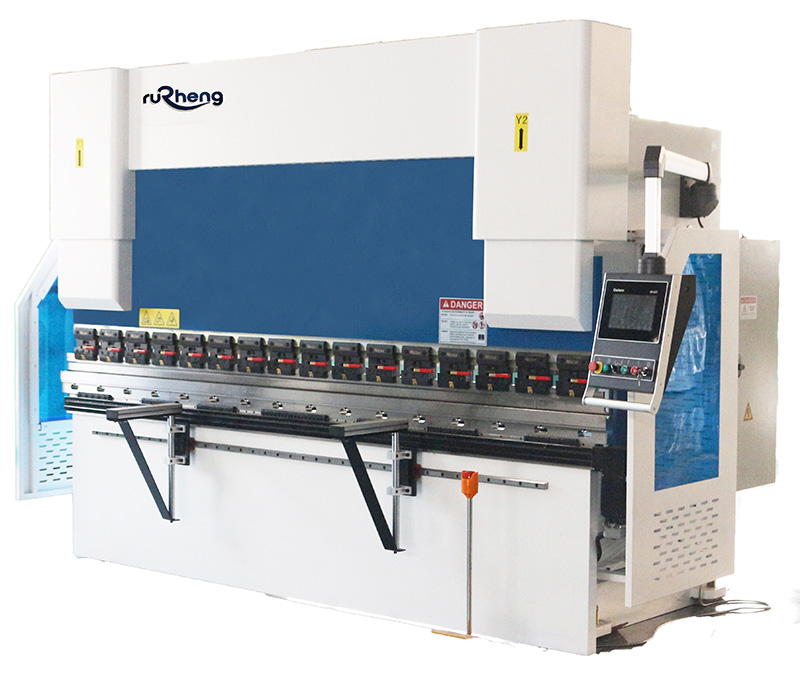
CNC press brake bends electrical enclosure sidewalls, door panels, and flange edges with high precision
Whether you are setting up a new fabrication shop, sourcing enclosures for a project, or looking to upgrade your production line, understanding the machines and processes involved is essential for making the right equipment decisions.
1. What Is Electrical Panel Enclosure Fabrication?
Electrical panel enclosure fabrication is the process of manufacturing protective metal cabinets that contain and protect electrical and electronic components. These enclosures range from small junction boxes (200 × 200 × 100 mm) to large motor control centers (2000 × 800 × 600 mm) and must meet strict standards for mechanical strength, ingress protection (IP ratings), and surface finish.
The fabrication process covers material selection, cutting and punching operations, bending and forming, welding and assembly, surface treatment, and hardware installation. Each stage requires specific machines and tooling to achieve the dimensional accuracy, aesthetic quality, and protective properties that industry standards demand.
Enclosures are manufactured from flat metal sheets — typically 0.8 mm to 3.0 mm thick — that are cut, punched, and bent into the multi-sided cabinet structure. Common enclosure types include wall-mount cabinets, floor-standing distribution panels, console desks for operator interfaces, and weatherproof enclosures for outdoor installations.
2. Common Enclosure Materials
Material selection for electrical enclosures depends on the application environment, required IP rating, corrosion resistance needs, and budget constraints.
| Material | Thickness Range | Key Properties | Typical Applications |
|---|---|---|---|
| Cold-Rolled Steel (CRS) | 0.8–2.0 mm | High strength, excellent bending, paintable surface | Indoor enclosures, distribution boards |
| Galvanized Steel | 0.8–2.5 mm | Zinc coating, corrosion resistant | Indoor/outdoor enclosures, outdoor cabinets |
| Stainless Steel 304 | 1.0–2.0 mm | Corrosion resistant, food-grade, easy cleaning | Food processing, chemical plants, wet environments |
| Stainless Steel 316 | 1.0–2.0 mm | Superior corrosion resistance, marine-grade | Marine, coastal, offshore installations |
| Aluminum 5052-H32 | 1.0–2.5 mm | Lightweight, corrosion resistant, EMI shielding | Portable enclosures, aerospace, EMI-sensitive equipment |
| Aluminum 6061-T6 | 1.5–3.0 mm | High strength, good machinability | Heavy-duty industrial enclosures |
3. The 4 Core Machines for Enclosure Fabrication
3.1 Fiber Laser Cutting Machine — Precision Cutouts and Profiles

Fiber laser cutting machine creates precise cutouts for panel doors, ventilation grilles, and cable entry points
A fiber laser cutting machine is the primary cutting tool for electrical enclosure fabrication in modern shops. It uses a fiber optic laser source (typically 1–6 kW) to cut flat sheet metal with high precision, producing smooth edges that often require no secondary deburring.
For electrical enclosures, laser cutting handles several critical operations: cutting the enclosure body panels to size from flat blanks, creating cutouts for doors, windows, and display panels, cutting ventilation slot patterns for heat dissipation, and producing custom-shaped panels for fittings and accessories.
Fiber lasers have largely replaced CO2 lasers in sheet metal fabrication due to their superior cutting speed on thin-to-medium materials (0.8–6.0 mm), lower operating costs, and better energy efficiency. Modern fiber laser machines include automatic focus adjustment, real-time cutting parameter optimization via CNC controls, and integrated CAD/CAM software for direct programming from DXF or DWG files.
3.2 CNC Punch Press — Mounting Holes and Ventilation Patterns

CNC turret punch press rapidly creates mounting holes and louvered ventilation patterns on enclosure panels
A CNC punch press — also called a turret punch or CNC punching machine — uses dies and punches to create holes, slots, and specialized shapes in sheet metal at high speed. For electrical enclosure fabrication, it is the fastest method for producing repetitive features like mounting holes for DIN rails, ventilation louvers, cable gland entries, and ground stud holes.
Modern CNC punch presses feature servo-electric or hybrid servo-hydraulic drives that offer high accuracy (positioning accuracy ±0.05 mm) with lower energy consumption than fully hydraulic machines. The turret holds 15–30 tool stations, allowing rapid changeover between hole sizes and shapes without stopping production.
For high-volume enclosure production, "high-speed" or "high-hit-rate" punching machines can achieve 600–1,200 strokes per minute, making them significantly faster than laser cutting for repetition-heavy hole patterns. However, for complex cutout shapes (irregular panel windows, custom display cutouts), a fiber laser remains the more versatile choice.
The choice between laser and punch for enclosure production depends on volume and complexity. High-volume standard enclosures (100+ identical panels) benefit from punch press speed, while custom or complex-shaped enclosures are better suited to laser cutting.
3.3 CNC Press Brake — Bending Walls, Flanges, and Door Panels

CNC press brake forms enclosure sidewalls, top and bottom flanges, and hinged door panels to precise angles
The CNC press brake is the most critical machine in electrical enclosure fabrication. It bends flat metal panels into three-dimensional enclosure shapes — sidewalls, top and bottom frames, door panels, and mounting brackets — using programmable back gauges and ram positioning to achieve consistent bend angles across production runs.
Electrical enclosure bending on a press brake typically requires multiple operations per panel. Common bends include: 90-degree flanges on all four edges of a rectangular enclosure body (creating a box shape), door panel bends with integrated hinge preparations, mounting tab bends for back panels and DIN rails, and louvered ventilation patterns formed directly on the press brake using specialized louver tooling.
Key press brake specifications for enclosure work include: tonnage (typically 40–160 tons depending on material thickness and panel size), table length (must accommodate the longest panel, commonly 2500–3200 mm), back gauge axes (X, R, Z1, Z2 for multi-axis positioning accuracy), and crowning system (essential for consistent bend angle across wide panels — mechanical or hydraulic crowning compensates for machine frame deflection).
For production efficiency, a robotic press brake bending system — where a robot arm loads and unloads panels between bends — is increasingly common in high-volume enclosure manufacturing. These cells can operate unattended for extended periods, significantly reducing labor costs per part.
3.4 Surface Treatment Equipment — Pickling, Powder Coating, and Finishing
After cutting and bending, enclosure panels receive surface treatment to provide corrosion resistance, aesthetic finish, and compatibility with the installation environment. The standard finishing process for steel enclosures includes acid pickling (to remove rust, scale, and mill residues), phosphating (for improved paint adhesion), and powder coating (for a durable, uniform finish available in RAL color codes).
Powder coating is preferred for electrical enclosures because it provides a thicker, more durable finish than wet paint, is environmentally friendly (zero VOC emissions), and offers excellent edge coverage that protects cut edges from corrosion. The process involves electrostatic spray application of dry powder, followed by curing in an oven at 160–200°C for 10–20 minutes.
For outdoor or marine-grade enclosures, additional treatments such as zinc-rich primer, multi-coat paint systems, or hot-dip galvanizing may be specified. Stainless steel enclosures typically require only mechanical polishing or electropolishing to achieve the desired surface finish.
4. Electrical Enclosure Fabrication Process Flow
A typical electrical panel enclosure production line runs through these sequential stages:
Material Preparation and Cutting
Flat sheets (or laser-cut blanks from a previous run) are prepared. A fiber laser or CNC shear cuts the sheet to the required panel dimensions with ±0.5 mm accuracy.
Punching — Holes, Slots, and Knockouts
A CNC punch press or laser cutting machine creates all mounting holes, ventilation slots, cable entry knockouts, and any panel window cutouts. For high-volume runs, turret punch presses can produce these features at 600+ hits per minute.
Bending — Forming the Enclosure Shape
A CNC press brake bends each panel to its final shape. Typical operations include 4-sided flanges on body panels, door panel bends with integrated hinge pin preparations, and mounting tab bends. Multi-axis back gauges ensure repeatability across identical parts.
Welding and Assembly
Corner joints are welded (MIG/TIG for stainless steel, MIG for carbon steel) to create the complete enclosure body. Seam sealing is applied where required for IP-rated enclosures. Door panels are fitted with hinges and latches.
Surface Treatment and Finishing
Welded and assembled enclosures undergo acid pickling, phosphating, and powder coating to achieve the final surface finish and corrosion protection. Stainless steel enclosures are passivated or polished.
Hardware Installation and Quality Inspection
Final assembly includes mounting DIN rails, earth studs, cable glands, door locks, and any integrated components. Each enclosure is inspected for dimensional accuracy, weld quality, IP rating compliance, and surface finish before packing and shipping.
5. Key Machine Specifications for Enclosure Production
| Machine | Key Specs for Enclosure Work | Typical Range |
|---|---|---|
| Fiber Laser Cutter | Power, cutting bed size, positioning accuracy | 1–6 kW; 1500 × 3000 mm bed; ±0.05 mm accuracy |
| CNC Punch Press | Turret stations, hit rate, max thickness | 20–30 stations; 600–1200 hits/min; up to 6 mm |
| CNC Press Brake | Tonnage, table length, back gauge axes, crowning | 40–160 tons; 2500–3200 mm; 4–6 axis; mechanical/hydraulic |
| Powder Coating System | Oven size, cure temperature, spray system type | Up to 3000 × 2000 × 2500 mm; 160–200°C cure |
Recommended Machine Configurations by Cabinet Type
Electrical cabinet manufacturers should not buy each machine in isolation. The cutting method, hole volume, bend sequence and final cabinet size decide whether the line should prioritize flexibility, punching speed or bending automation.
| Production target | Cutting and punching | Cabinet press brake | Best fit |
|---|---|---|---|
| Custom control boxes and small batches | 1-2 kW fiber laser, optional compact punch | 63T/2500 mm or 80T/2500 mm CNC hydraulic press brake | Flexible job-shop production with frequent drawings and material changes. |
| Wall-mount cabinets and distribution boxes | 2-3 kW fiber laser plus CNC punch for louvers and repeated holes | 80T/2500 mm or 100T/3200 mm press brake with 4-axis back gauge | Balanced output for steel, galvanized steel and stainless enclosure panels. |
| Floor-standing electrical cabinets | 3-6 kW fiber laser or punch-laser workflow | 100T/3200 mm or 125T/3200 mm CNC press brake with crowning | Long doors, side panels and repeated flange bending with stable angle accuracy. |
| High-volume standard enclosure production | High-speed CNC punching machine for hole patterns, laser for flexible cutouts | 100T-160T press brake, 6-axis back gauge or robotic press brake option | Repeatable panel families where setup time and labor cost drive total cost. |
| Stainless or outdoor IP-rated cabinets | Fiber laser with nitrogen cutting and clean edge quality | 100T-160T press brake with polished tooling, crowning and careful die selection | Visible surfaces, corrosion resistance and tight door sealing requirements. |
Cabinet Press Brake Selection Rules
For electrical enclosure bending, the press brake must handle more than tonnage. Box-shaped panels often need segmented punches, gooseneck punches, deep throat clearance and accurate back gauge positioning so previously bent flanges do not collide with the tooling or machine frame.
| Decision point | Recommended starting point | Why it matters for enclosures |
|---|---|---|
| Tonnage | 63T-125T for most 1.0-3.0 mm enclosure work | Enough reserve for stainless steel, full-length bends and narrower V dies. |
| Working length | 2500 mm for compact panels, 3200 mm for long doors and cabinet sides | The longest bend length controls the required machine bed size. |
| Back gauge | X/R with Z1/Z2 fingers for repeated cabinet panels | Reduces manual positioning time and keeps holes, flanges and door edges aligned. |
| Crowning | Mechanical or CNC hydraulic crowning for long panels | Maintains consistent angles across wide enclosure doors and sidewalls. |
| Tooling | Segmented upper tools, gooseneck punches, V dies and mark-free options | Allows box bending, return flanges and stainless surfaces with fewer defects. |
For an accurate FOB China proposal, send the cabinet drawings, maximum panel size, material grade, thickness range, longest bend length, hole and louver volume, surface finish requirement, voltage, daily production target and preferred controller. Rucheng can then match the fiber laser cutter, CNC punching machine, press brake machine and press brake tooling.
6. Enclosure Types and Machine Fit
Different electrical enclosure types make different demands on the production equipment. Understanding these demands helps in machine selection and production planning.
| Enclosure Type | Primary Machine | Secondary Machine | Difficulty |
|---|---|---|---|
| Wall-Mount Cabinet (Small) | Laser cutter + Press brake | Hand tools for assembly | Low |
| Wall-Mount Cabinet (Large) | Laser + Punch + Press brake | Welding station | Medium |
| Floor-Standing Distribution Panel | Punch + Press brake | Laser (for complex cutouts), welding | Medium |
| Motor Control Center (MCC) | Punch + Press brake + Welding | Laser, automated finishing | High |
| Stainless Steel Enclosure | Laser + Press brake (clean) | TIG welding, electropolishing | High |
| Outdoor Weatherproof Enclosure | Press brake + Welding | Specialty coating system | Medium-High |
7. Standards and Certifications
Electrical enclosures must meet specific international and regional standards that define mechanical properties, ingress protection levels, and testing requirements.
The most widely referenced standards include IEC 62208 (international — empty enclosures for low-voltage switchgear), UL 50/50E (North America — enclosures for electrical equipment), NEMA Type 1, 3R, 4, 4X, 12 (USA — environmental ratings for industrial enclosures), IP65 / IP66 / IP67 (international — ingress protection against dust and water), and RoHS / REACH (environmental compliance for materials).
Fabricators targeting international markets should design their enclosures and finishing processes to meet these standards from the outset, as retrofitting for compliance is costly and time-consuming. Working with a manufacturer that has existing third-party certification testing (UL, TÜV, CSA) significantly accelerates the approval process for new enclosure designs.
8. FAQ
What press brake is best for electrical cabinet fabrication?
Most electrical cabinet fabrication shops start with a 63T-125T CNC hydraulic press brake and 2500-3200 mm working length. Choose 2500 mm for compact control boxes and 3200 mm for long doors, side panels and floor-standing cabinets. Add CNC crowning for long bends, X/R/Z1/Z2 back gauges for repeated panels, and segmented or gooseneck tooling for box-shaped enclosure bends.
Do electrical enclosure manufacturers need both laser cutting and CNC punching?
Many enclosure factories use both. A fiber laser is better for flexible panel shapes, windows, small batches and frequent drawing changes. A CNC punching machine is faster for repeated holes, louvers, knockouts and DIN rail mounting patterns. If production volume is low, a laser-only workflow can start first; if standard cabinet panels repeat every day, adding a punch press can reduce cost per part.
What machines are required for electrical panel enclosure fabrication?
The core machines are a fiber laser cutter (for panel cutting and cutouts), a CNC punch press or laser (for holes and slots), a CNC press brake (for bending enclosure walls, flanges, and door panels), and surface treatment equipment (pickling, phosphating, powder coating line). A welding station is needed for assembling multi-piece enclosure bodies.
Can a single CNC press brake handle all enclosure bending work?
A CNC press brake is versatile enough to bend most enclosure panel shapes, but its effectiveness depends on panel size, material thickness, and complexity. For small-to-medium enclosures (up to 1200 × 800 mm) in 1.0–2.0 mm sheet, a 100-ton press brake with 2500 mm table handles most operations. Large enclosures and heavy-gauge stainless steel may require larger machines (160–200 tons, 3200+ mm table).
What is the typical production volume for enclosure fabrication?
Production volumes vary widely: custom one-off enclosures may take 4–8 hours per unit from drawing to finish. Semi-automated production of standard enclosures (wall-mount cabinets, distribution panels) typically achieves 20–50 units per shift with a well-equipped shop. Fully automated lines with robotic press brake bending and automated finishing can produce 100–200+ units per shift on identical or near-identical parts.
What material thickness is most common for electrical enclosures?
The most common range is 1.0–2.0 mm for steel enclosures and 1.5–2.5 mm for aluminum. Light-duty indoor enclosures typically use 1.0–1.5 mm cold-rolled or galvanized steel. Heavy-duty floor-standing enclosures and MCC buckets commonly use 1.5–2.5 mm. Stainless steel enclosures for harsh environments typically use 1.5–2.0 mm for optimal strength-to-weight ratio.
How do I choose between laser cutting and punch press for enclosure production?
Choose laser cutting for: complex cutout shapes, small-to-medium batch sizes, custom designs, smooth edge quality, and frequent changeovers between part types. Choose punch press for: high-volume production of identical panels, repetitive hole patterns (DIN rail holes, gland plate knockouts), high-speed louver production, and parts where the forming capability of a punch (louvres, extrusions) is advantageous. Many modern shops use both machines in the same production line — laser for flexibility, punch for speed on standard features.
What IP rating can a standard welded steel enclosure achieve?
A properly seam-welded steel enclosure with foam gasket door seals and appropriate hardware can achieve IP65 as standard, with IP66 and IP67 achievable through additional design measures (continuous weld seams, heavy-duty gasket systems, pressure-equalization vents with membranes). Achieving higher IP ratings requires precision fabrication, continuous weld seams, and specialized gasket and hardware solutions.
What information is needed for an FOB China electrical cabinet machine quote?
Send cabinet drawings, maximum panel size, material grade, thickness range, longest bend length, hole and louver quantity, required surface finish, daily production target, workshop voltage, controller preference and destination port. These details decide the laser power, punch configuration, press brake tonnage, working length, crowning, tooling and packaging plan.
9. Conclusion
Electrical panel enclosure fabrication is a multi-stage process that combines precision cutting, high-speed punching, controlled bending, and professional finishing. The key to a successful production line is matching machine capabilities to your target enclosure types, volumes, and quality requirements.
A fiber laser provides the flexibility to cut complex shapes and custom panels. A CNC punch press adds the speed needed for high-volume hole and slot production. A CNC press brake with multi-axis back gauge and crowning delivers the bending accuracy that determines whether an enclosure's dimensions and tolerances meet specification. And a properly specified finishing line ensures the final product not only looks professional but withstands its intended operating environment.
For related process planning, compare this workflow with our sheet metal fabrication guide, fiber laser cutting machine buying guide, and press brake force calculation guide.
For manufacturers planning an enclosure production line or evaluating equipment upgrades, contact Rucheng for machine recommendations matched to your enclosure types, material specifications, and production targets.
Ready to Set Up Your Electrical Enclosure Production Line?
Get expert recommendations on laser cutters, CNC punch presses, press brakes, and finishing systems for electrical cabinet manufacturing. Rucheng supplies individual machines and complete turnkey production lines.
Request a Quote →Plan the complete sheet metal production line
Most application projects need cutting, bending and downstream assembly to work together. Start with the fiber laser cutting machine range for blanks and profiles, then match the parts with the right press brake machine for bending.
- Laser power selection helps size cutting capacity by material and thickness.
- Press brake tonnage calculation helps size bending capacity by material, length and V-die opening.
- Sheet metal factory setup connects laser cutting, punching, shearing, bending and forming equipment into one workflow.