
The best cable tray manufacturing machine setup depends on whether you make straight tray sections, fittings or accessories. Use a CNC punching machine for mounting holes, slots, louvers and repeated patterns; use a CNC press brake for flanges, brackets, elbows, tees and reducers; use a fiber laser cutting machine or hydraulic shearing machine for blanks; and use custom molds and dies to keep repeated accessories accurate. For high-volume straight tray sections, add a roll forming line. For mixed products such as cable tray accessories, pipe supports, metal brackets and sheet metal components, a flexible punching + bending + cutting cell is often the better first investment.
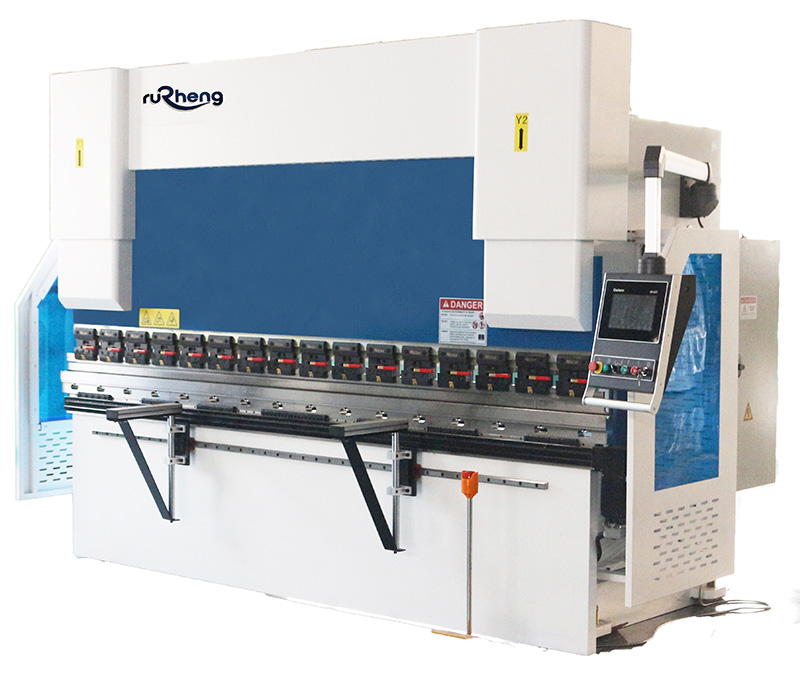
CNC press brake used for bending cable tray sidewalls and flange edges
This guide walks through each core machine, how they fit into a typical production line, what specifications to evaluate, and how to match machine choices to the cable tray sections, accessories, pipe supports, metal brackets and sheet metal components you plan to manufacture. For broader equipment selection, compare the press brake machine hub, CNC punching machine hub, laser cutting machine hub, shearing machine hub, and the sheet metal fabrication cost reduction guide.
Quick Answer: Which Machines Do You Need?
If you want to manufacture cable tray accessories and related sheet metal components, start with the product drawings. Parts with many holes and slots need a CNC punching machine. Parts with flanges, U-shapes, brackets or support bends need a press brake machine. Flat blanks can be prepared by a fiber laser cutting machine for flexible shapes or a hydraulic shearing machine for straight rectangular blanks. Repeated hole patterns, louver forming, embossing and bending accuracy depend on suitable molds and dies.
| Buyer Product | Main Processes | Recommended Machine Combination |
|---|---|---|
| Cable tray accessories | Blank cutting, punching, slotting, bending, fitting assembly | CNC punching machine + press brake + laser cutting or shearing + custom molds |
| Pipe supports | Hole punching, U-bending, bracket forming, thick sheet cutting | CNC punching machine + hydraulic press brake + tooling set |
| Metal brackets | Profile cutting, hole punching, multi-bend forming | Fiber laser cutting machine or CNC punching machine + press brake |
| Standard straight cable tray sections | Decoiling, punching, roll forming, flying shearing | Roll forming line + inline punching + flying shear + press brake for fittings |
1. What Is Cable Tray Manufacturing?
Cable tray manufacturing is the process of forming, cutting, and finishing metal profiles that support and route electrical cables in buildings and industrial facilities. Unlike cable conduit, which is typically a single tube, cable tray systems come in multiple structural forms — ladder, perforated, solid bottom, channel, and wire mesh — each requiring different forming and cutting operations.
The manufacturing process starts with metal coils (galvanized steel, stainless steel, or aluminum, typically 0.6 mm to 3.0 mm thick) and ends with finished tray sections ready for installation. Key operations include: decoiling and leveling, punching holes or slots, roll forming the tray profile, secondary bending on a press brake, and shearing to final length.
Cable trays are produced either as individual sections (typically 2–3 meters long) or as part of an automated production line that handles all operations in sequence. The choice between a manual workstation setup and a fully automated line depends on production volume, tray type variety, and required tolerances.
2. The 4 Core Machines for Cable Tray Production
2.1 Roll Forming Machine — The Profile Shaper
A roll forming machine is the workhorse of cable tray production. It continuously passes a metal strip through a series of roller stations, each progressively shaping the material into the desired tray profile — typically a U-channel, C-channel, or ladder-side configuration.
A complete cable tray roll forming line includes: an automatic hydraulic decoiler, a leveling unit, a servo feeder, a hydraulic punch machine (for knockouts and mounting holes), the roll forming stations, and a flying shear or fixed-length shear at the output. Production speeds commonly range from 10 to 40 meters per minute depending on material thickness and profile complexity.
Roll forming is ideal for high-volume production of standard tray profiles. Changeover between different tray widths or heights requires changing the roller tooling — a process that typically takes 1–3 hours for a well-prepared shop.
2.2 CNC Press Brake — Secondary Bending and Flange Forming

CNC press brake enables precise flange bending and profile corrections after roll forming
After roll forming, cable tray profiles often require secondary operations that a press brake handles: adding flange bends, closing or opening tray sidewalls, forming connection tabs, or creating fitting attachments (elbows, tees, and crosses that are not easily produced on a roll line).
A CNC press brake with an advanced controller (Delem, ESA, or Cybelec) is preferred because cable tray bending often requires multiple bends per part with precise back gauge positioning. Tonnage requirements are typically moderate: 40–160 tons depending on material thickness and tray width. For high-volume fitting production, a tandem press brake setup (two machines working in sequence) can double output.
Key specifications for cable tray press brake work include: table length (must accommodate the longest tray section, typically 2500–3200 mm), stroke count per minute, back gauge axis count (X, R, Z1, Z2 for multi-axis positioning), and crowning system for consistent bend quality across wide trays.
2.3 Punch Press — Hole and Slot Creation

CNC punch press creates mounting holes and ventilation slots in cable tray walls
Punch presses create the holes, knockouts, and slots that make cable trays functional: mounting holes for hanging brackets, ventilation slots for heat dissipation in power cable runs, and prepunched connection points for joining sections without drilling in the field.
Two main punch configurations are used in cable tray production. Turret punch presses hold multiple tool stations in a rotating turret, allowing rapid changeover between hole sizes and shapes without stopping production. CNC punching machines with servo-electric or hydraulic drives offer high accuracy and are well-suited for regular perforation patterns along tray sidewalls.
For high-speed cable tray lines, "flying die" or "tight-line" punching systems move the material continuously while the punch head travels with the strip — eliminating the start-stop rhythm of conventional punch presses and significantly increasing throughput on perforation-heavy tray designs.
2.4 Shearing Line — Cutting to Length
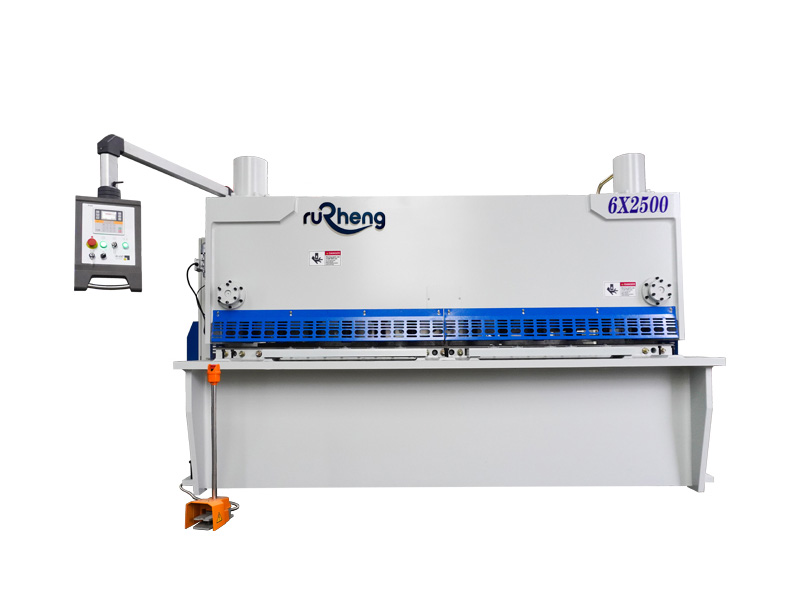
Guillotine shearing line provides clean, square cuts on cable tray sections
Shearing machines cut the formed tray profile to its final commercial length. The two main types used in cable tray production are guillotine shears (straight-blade hydraulic shear) and swing beam shears (pendulum shear). Both produce a clean, square cut at the required length with minimal distortion.
Guillotine shears use a fixed upper blade and moving lower blade, delivering high cutting accuracy and smooth cut surfaces on material up to 6 mm thick. Swing beam shears offer faster cycle times and are better suited for thinner materials (0.6–3.0 mm), which covers most cable tray applications. Both types can be integrated into an automated line with a servo feeder for cut-to-length precision of ±0.5 mm or better.
A flying shear — one that moves with the strip during cutting — is preferred in high-speed roll forming lines, as it eliminates the pause-and-cut cycle and maintains continuous production flow.
3. Cable Tray Production Process Flow
A typical automated cable tray production line runs through these stages in sequence:
Decoiling and Leveling
A hydraulic decoiler unwinds the metal coil; a multi-roller leveler removes coil set and ensures a flat, stress-free strip ready for punching and forming.
Punching — Holes, Slots, and Knockouts
A CNC punch press or flying die system creates mounting holes, ventilation slots, and connection prepunches while the strip is still flat, before it enters the roll form stations.
Roll Forming — Profile Creation
The leveled and punched strip passes through progressive roll form stations that shape it into the target cable tray profile — ladder rail, perforated sidewall, or solid bottom channel.
Secondary Bending on Press Brake
For tray fittings (bends, tees, crosses) or parts requiring flange adjustments, the formed profile moves to a CNC press brake for additional bending operations.
Shearing — Cut to Length
A guillotine or flying shear cuts the continuous tray profile to the required commercial length (typically 2,000–3,000 mm).
Stacking, Bundling, and Finishing
Finished sections are automatically stacked, bundled, and may receive additional finishing such as zinc plating, powder coating, or hot-dip galvanizing depending on the corrosion protection requirements.

Swing beam shear provides fast, clean shearing of formed cable tray sections
4. Cable Tray Types and Machine Fit
Different cable tray designs make different demands on the production line. Matching tray type to machine configuration is one of the most important selection decisions.
| Tray Type | Roll Forming | Punch Press | Press Brake | Shearing |
|---|---|---|---|---|
| Ladder Tray | Primary — rung insertion stations needed | Moderate — bolt hole patterns on rails | Low — mostly straight sections | Standard cutting |
| Perforated Tray | Standard roll forming with perforation tooling | Heavy — ventilation slot patterns throughout | Low to moderate | Standard cutting |
| Solid Bottom Tray | Standard roll forming, solid walls | Low — mostly mounting holes at ends | Moderate — flange closing may be needed | Standard cutting |
| Channel Tray | Simple U-channel profile | Low to moderate | Low — rarely needs secondary forming | Standard cutting |
| Wire Mesh Tray | Welded wire mesh, not roll formed | Minimal | Minimal | Standard cutting |
| Tray Fittings (Elbows, Tees) | Not produced on roll line | Connection hole patterns | Primary — all fitting bending on press brake | Cutting of fitting components |
The fitting category is particularly important: elbows, tees, crosses, and reducers cannot be produced on a standard roll forming line. These are always made on a CNC press brake from flat blank pieces, then joined and finished. A well-equipped cable tray shop needs both a high-speed roll line for standard sections and a capable press brake for fittings production.
5. Key Specifications and Selection Guide
| Machine | Key Specs for Cable Tray | Typical Range |
|---|---|---|
| Roll Forming Line | Material thickness, strip width, profile height, line speed | 0.6–3.0 mm; 50–600 mm wide; 10–40 m/min |
| CNC Press Brake | Tonnage, table length, back gauge axes, crowning | 40–200 tons; 2500–3200 mm table; 4–6 axis back gauge |
| Punch Press | Turret size, hit rate, max material thickness, servo or hydraulic | 20–30 station turret; 200–1000 hits/min; up to 6 mm |
| Shearing Line | Cutting width, blade gap adjustment, cutting length accuracy | Up to 1600 mm cut width; ±0.5 mm length accuracy |
5.1 Roll Forming Line vs. Press Brake-Only Setup
Shops starting in cable tray manufacturing face a fundamental choice: invest in a dedicated roll forming line, or build a more flexible workstation around a CNC press brake?
A roll forming line delivers the highest output for standard section production — once the profile and tooling are set up, it runs at 10–40 m/min with minimal labor. It is the right choice for dedicated high-volume tray manufacturers producing the same profile every day.
A press brake-centric setup (laser cutting or shearing flat blanks, then press brake forming) trades throughput for flexibility. It handles a wider variety of tray types, custom sizes, and fitting production without the changeover penalty of a roll line. This approach suits fabrication shops adding cable tray to their product mix or manufacturers serving project-based orders with high variety.
5.2 Automation and Integration
Modern cable tray lines increasingly integrate with factory management systems (MES/ERP) for order scheduling, production tracking, and quality logging. Key integration points include: NC program storage and recall for quick product changeover, barcode or QR-code scanning to load the correct program for each tray type, automatic tool positioning on punch presses, and conveyor and stacking automation to reduce manual handling.
For manufacturers targeting international markets, cable tray production lines should be designed to meet relevant standards such as NEMA VE 1 (USA), IEC 61537 (international), and BS EN 61537 (Europe), which specify mechanical properties, load ratings, corrosion resistance, and surface treatment requirements.
6. Quote Checklist for Cable Tray Accessories, Pipe Supports and Brackets
To recommend the right CNC punching, press brake, laser cutting, shearing and tooling setup, Rucheng needs the product and production details first. A complete checklist helps avoid quoting a machine that is too small, too slow, or missing key tooling.
| Information Needed | Why It Matters |
|---|---|
| Product drawings or sample photos | Defines hole patterns, bending sequence, tooling, blank shape and machine travel requirements. |
| Material type and thickness range | Determines press brake tonnage, punching force, laser power or shear capacity. |
| Maximum sheet size or coil width | Defines machine table size, feeder size, back gauge range and cutting width. |
| Hole, slot, louver and forming requirements | Determines whether standard punch tooling is enough or custom molds are required. |
| Daily or monthly production quantity | Helps choose between flexible standalone machines and a more automated production line. |
| Workshop voltage, available air and gas | Confirms electrical configuration and whether laser assist gas or pneumatic tooling is practical. |
For a press brake-focused quotation, use the press brake quote form. For a cutting-focused quotation, use the laser cutting machine quote form. If you need a complete cable tray accessories line with punching, bending, cutting and molds, send Rucheng your drawings and production target so we can recommend a machine combination.
7. FAQ
What machines are needed to start cable tray manufacturing?
The minimum setup for basic cable tray production includes a leveler or manual decoiler, a punch press or laser cutting system for holes, a roll forming machine or press brake for shaping, and a shearing machine for cutting to length. A fully equipped shop adds an automatic decoiler, flying die punch, multi-station roll former, CNC press brake with multi-axis back gauge, and automated stacking.
Can a CNC press brake replace a roll forming line for cable tray?
A CNC press brake can produce cable tray sections from flat blanks, but it is significantly slower than a roll forming line for straight section production. Press brake forming is better reserved for tray fittings (elbows, tees, reducers) and custom profiles where the volume does not justify dedicated roll tooling. For any serious cable tray volume, a roll line and a press brake work best as complementary machines.
What material thicknesses are used in cable tray manufacturing?
The most common range is 0.6 mm to 3.0 mm. Light-duty perforated and wire mesh trays typically use 0.6–1.5 mm galvanized steel or aluminum. Medium-duty ladder and solid bottom trays commonly use 1.5–2.5 mm. Heavy-duty industrial trays for high-load applications may reach 3.0 mm or thicker, particularly in stainless steel or hot-dip galvanized formats.
What is the typical production speed of a cable tray roll forming line?
Production speeds range from 10 to 40 meters per minute depending on material thickness, profile complexity, and the number of roll stations. Thinner materials (0.6–1.0 mm) can often run at the higher end of this range. Heavier materials (2.0–3.0 mm) typically run at the lower end due to the greater forces involved.
How do I choose between a guillotine shear and a swing beam shear for cable tray?
Guillotine shears provide higher cutting accuracy and a cleaner cut on wider and thicker material — better suited for heavy industrial cable trays. Swing beam shears are faster and more energy-efficient for thin-to-medium material (0.6–3.0 mm), which covers most standard cable tray production. For an integrated production line, a flying shear synchronized with the roll forming speed offers the best combination of speed and precision.
Can one machine make cable tray accessories, pipe supports and metal brackets?
No single machine is the best choice for every operation. A CNC punching machine handles repeated holes, slots and formed features; a press brake handles bends and bracket shapes; a laser cutting or shearing machine prepares blanks; and molds or dies control repeated shapes. For mixed sheet metal components, a flexible punching + bending + cutting cell is usually better than a single-purpose roll forming line.
What information should I send for a cable tray machine recommendation?
Send tray drawings, material grade, thickness range, tray width and height, hole or slot patterns, accessory types, monthly output target, workshop voltage and whether you need punching, bending, laser cutting, shearing or molds. Rucheng can then match the equipment cell to straight tray sections, fittings and brackets.
Should cable tray accessories use a press brake or a roll forming line?
Use a roll forming line for high-volume straight tray sections with stable profiles. Use a CNC press brake for elbows, tees, reducers, covers, brackets and project-based accessories where the product mix changes often.
8. Conclusion
Cable tray manufacturing is a specialist discipline that requires coordinated investment across several machine types. A roll forming line handles high-volume profile production. A CNC press brake adds the fitting and custom-bending capability that makes a shop truly flexible. A punch press or flying die system delivers the hole and slot patterns that make trays functional. A shearing line closes the process with accurate cut-to-length output.
The most effective cable tray manufacturers run all four machine types in an integrated or semi-integrated setup, using the roll line for standard section output and the press brake for fittings, custom work, and rapid response to project requirements. Together, these machines deliver the combination of throughput, precision, and flexibility that the cable tray market demands in 2026.
For adjacent fabrication markets with similar bending, punching, and cost-control requirements, review our metal storage rack manufacturing guide, solar mounting structure fabrication guide, and sheet metal fabrication cost reduction guide.
If you are planning a cable tray production line or evaluating equipment upgrades, contact Rucheng for machine recommendations matched to your tray types, material specifications, drawings and production targets.
Ready to Set Up Your Cable Tray Production Line?
Get expert recommendations on CNC punching machines, press brakes, laser cutting or shearing lines, and custom tooling for cable tray accessories, pipe supports and metal brackets.
Send Drawings for Recommendation →Plan the complete sheet metal production line
Most application projects need cutting, bending and downstream assembly to work together. Start with the fiber laser cutting machine range for blanks and profiles, then match the parts with the right press brake machine for bending.
- Laser power selection helps size cutting capacity by material and thickness.
- Press brake tonnage calculation helps size bending capacity by material, length and V-die opening.
- Sheet metal factory setup connects laser cutting, punching, shearing, bending and forming equipment into one workflow.