
Quick Answer: Which machine makes each rack part?
| Rack part | Main process | Recommended machine |
|---|---|---|
| Uprights and columns | Repeated hole punching, slot patterns, roll formed profile | CNC punching machine + roll forming line |
| Beams and crossbars | Cutting, end forming, bending and weld preparation | Press brake + shearing or laser cutting |
| Shelves, panels and guards | Blank cutting, corner notches, flange bending and punching | Fiber laser cutting machine + CNC press brake |
| Foot plates, brackets and braces | Thicker plate cutting, hole punching and multi-bend forming | Heavy-duty press brake + punching or laser cutting |
1. Material Selection and Preparation
The manufacturing process begins with selecting high-quality steel materials. Most storage racks are made from cold-rolled steel or galvanized steel coils, typically ranging from 0.5mm to 3.0mm thickness. The choice of material depends on the rack's load capacity requirements and intended environment.
Common material specifications include:
- Q235B carbon structural steel (most common)
- Q345B high-strength steel (for heavy-duty racks)
- Galvanized steel (for corrosion-resistant applications)
- Stainless steel 304/316 (for food and medical storage)
2. CNC Punch Press — The Heart of Rack Manufacturing

CNC punching machines are the most critical machines in storage rack manufacturing. These machines automatically create the precise hole patterns needed for assembling rack components — typically diamond holes, inverted eight holes, or butterfly holes with standard pitches of 50mm, 50.8mm, 75mm, or 76.2mm.
Key capabilities include:
- High-speed punching (80-300 strokes/min)
- Multiple tool stations (20-60 tools)
- Precision positioning (±0.1mm)
- Automatic tool changing
- Integration with CAD/CAM software
3. Laser Cutting for Precision Parts

While punch presses handle most hole-making, laser cutters are essential for complex profiles, notches, and detailed cuts that punches cannot achieve. Fiber laser cutters (1kW-6kW) provide excellent precision for:
- Complex geometric shapes
- Small batch production
- Prototyping new rack designs
- Intake and output openings
- Brackets and mounting plates
4. Roll Forming — Creating Rack Profiles
Roll forming machines are essential for producing the consistent U-shaped, C-shaped, or Omega-shaped profiles used for rack uprights (columns), beams, and crossbars. This continuous bending process offers:
- High production efficiency (10-30m/min)
- Excellent dimensional consistency
- Minimal material waste
- Lower labor costs (automated operation)
- Complex profile geometries
Modern roll forming lines integrate decoilers, levelers, servo feeders, punching stations, and cutting devices in a single production line.
5. Press Brake Bending
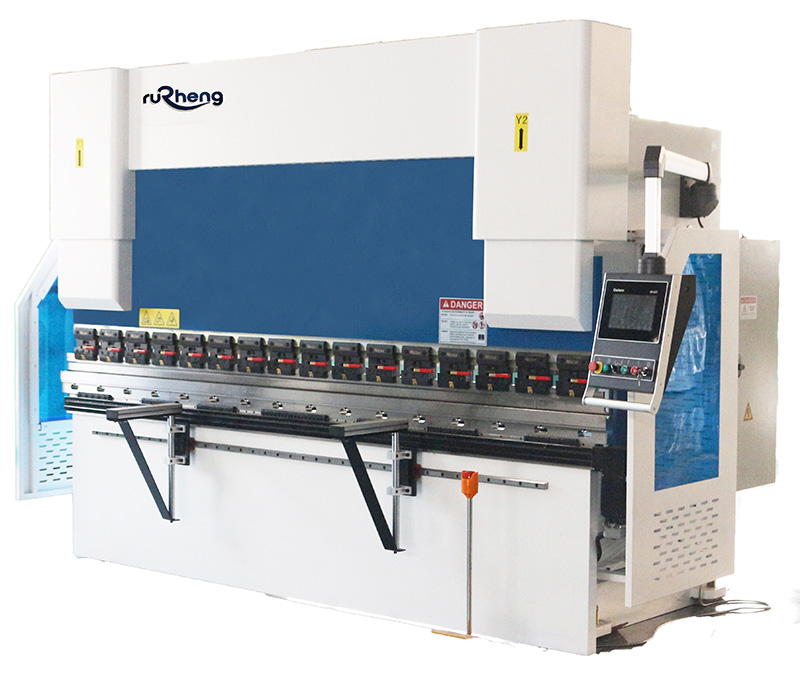
CNC press brakes handle the bending operations essential for rack manufacturing:
- Beam end forms (hook connections)
- Bracket and support bending
- Foot plate bending
- Safety guard bending
- Custom component fabrication
Modern CNC press brakes with CNC crowning systems ensure consistent bend angles across long profiles, critical for rack structural integrity.
6. Welding and Assembly
Once components are fabricated, welding assembles the rack structure. Common welding methods include:
- MIG/MAG welding (most common)
- Spot welding (for fast assembly)
- Robotic welding (for high-volume production)
- Projection welding (for nut and stud attachment)
After welding, grinding equipment smooths weld seams for both appearance and safety (preventing injuries from sharp edges).
7. Surface Treatment and Finishing
Surface treatment is crucial for rack durability and appearance. The standard process includes:
- Degreasing and cleaning
- Acid pickling (removes oxide scale)
- Phosphating (improves paint adhesion)
- Electrostatic powder coating
- Curing (180-200°C, 10-15 minutes)
For harsh environments, hot-dip galvanizing provides superior corrosion resistance, while epoxy coatings offer chemical resistance.
Manual vs Automated Production: Comparison
| Factor | Manual Production | Automated Line |
|---|---|---|
| Initial Investment | $50,000 - $200,000 | $500,000 - $2,000,000 |
| Production Speed | Slow (manual handling) | Fast (10-30m/min) |
| Labor Cost | High (3-5 operators) | Low (1-2 supervisors) |
| Consistency | Variable (operator skill) | High (CNC control) |
| Best For | Small batches, custom racks | Mass production, standard sizes |
| ROI Period | Short-term | 2-3 years |
Quality Control Standards
Professional rack manufacturers implement strict quality control following standards like:
- ISO 9001:2015 (Quality Management)
- ISO 3834-2 (Welding Quality)
- FEM 9.831 (Rack Load Testing)
- AS 4084 (Australian Steel Storage Racking)
- RMI/ANSI MH16.1 (US Rack Standards)
Need Help Choosing Rack Manufacturing Equipment?
For related fabrication workflows, compare this guide with our cable tray manufacturing machine guide, CNC punching machine page, sheet metal fabrication cost reduction guide, and press brake force calculation guide.
Our team can recommend the right sheet metal machines for your production needs and budget.
Request Rack Line Recommendation