
Press brake bend allowance is the length of material consumed by the curved portion of a sheet metal bend. K-factor is the ratio that locates the neutral axis inside the sheet thickness, and it is the key variable used to calculate accurate flat pattern length before bending.
| Need to solve | Use this page or tool | Next action |
|---|---|---|
| Bend allowance formula | This K-factor chart and worked examples | Choose a starting K-factor, radius and bend angle before calculating BA |
| Flat pattern calculator | Press brake bending calculator | Enter thickness, length, V-die and material to check bend allowance and tonnage |
| Inside radius and V-die | Minimum bend radius chart | Confirm whether the radius assumption matches the selected die opening |
| Machine tonnage | Press brake tonnage calculation | Check required force before locking the tooling and production route |
| Machine selection or quote | Press brake quote form | Send drawings, material, bend length, tolerance and production volume |
| When the calculation shows | Best machine fit | Why it fits |
|---|---|---|
| High-mix precision parts with frequent setup changes | Electro-hydraulic CNC press brake | Best for repeatable angle control, backgauge accuracy and stored bend tables |
| Long panels, poles or structural components | Tandem press brake | Handles long bend lines and synchronized multi-machine work |
| Heavy plate or very high tonnage jobs | Heavy-duty press brake | Built for larger force reserve and heavier sheet metal sections |
This guide explains bend allowance, K-factor, bend deduction, outside setback, and flat pattern length in practical press brake terms. It also shows how to transfer CAD sheet metal rules into real production by measuring the first part and updating your CNC controller or bend table.
Use this guide together with the press brake bending calculator for flat pattern checks, the minimum bend radius chart for V-die selection, the press brake force calculation guide for tonnage, CNC press brake programming basics for controller setup, the bend sequence guide for bend order, and the press brake safety checklist before releasing a new job to production.
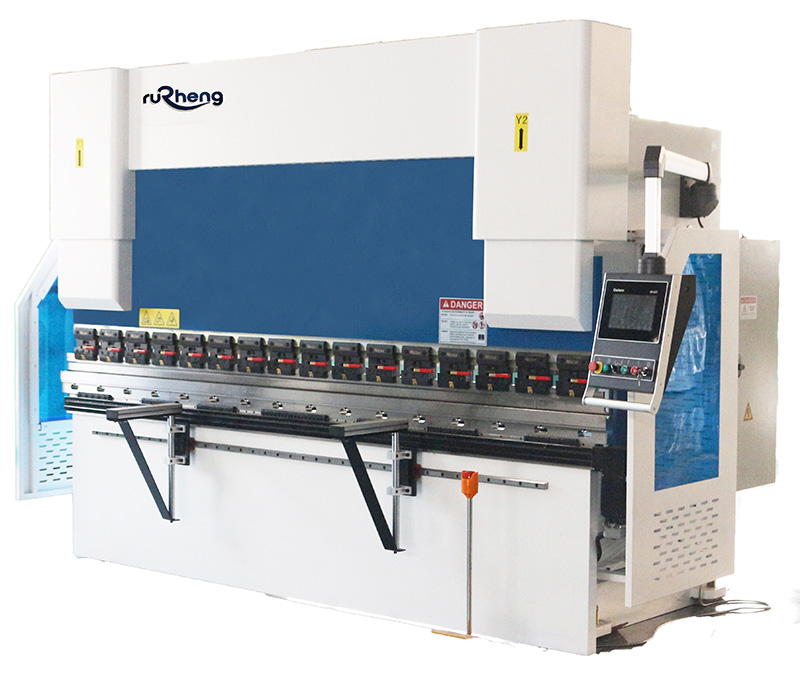
For equipment planning, compare the Rucheng press brake machine range and send material, thickness, bend length and tolerance requirements through the press brake quote form.
Bend Allowance, K-Factor and Bend Deduction Explained
A sheet metal part is designed as a finished 3D shape, but it is manufactured from a flat blank. The purpose of bend calculations is to predict the correct blank length so the final flange dimensions are correct after bending. When the sheet bends, material near the inside radius compresses, material near the outside radius stretches, and a neutral axis between them remains close to its original length.
K-factor describes where that neutral axis sits. If the neutral axis is one third of the material thickness from the inside surface, the K-factor is 0.33. CAD systems such as SOLIDWORKS and Autodesk Fusion use this concept in their sheet metal rules, but the value still has to match your real press brake process.
| Term | Meaning | Where You Use It |
|---|---|---|
| Bend allowance (BA) | Arc length through the neutral axis of the bend | Add to straight flange lengths when calculating a flat pattern |
| K-factor | Neutral axis location divided by material thickness | CAD sheet metal rules, CAM nesting, and bend table setup |
| Bend deduction (BD) | Amount subtracted from outside flange dimensions | Fast shop-floor blank calculations from outside dimensions |
| Outside setback (OSSB) | Distance from tangent point to outside mold line intersection | Bend deduction and layout calculations |
Press Brake Bend Allowance Formula
The standard bend allowance formula for press brake work is:
- BA = bend allowance, usually in mm or inches
- A = bend angle in degrees, measured through the bend
- R = inside bend radius
- K = K-factor
- T = material thickness
For a 90-degree bend, A x pi / 180 becomes 1.5708. That means a 90-degree bend allowance is simply 1.5708 x (R + K x T). The hard part is not the math. The hard part is choosing an inside radius and K-factor that match your actual press brake tooling and material.
Press Brake Bend Allowance Calculator Workflow
Use this worksheet before sending a drawing for quotation or before locking a CAD flat pattern. It turns the bend allowance formula into a repeatable shop-floor process that can be checked against the online bending calculator, the bend radius chart and the press brake tonnage guide.
| Calculator step | Input required | Example value | Why it matters |
|---|---|---|---|
| 1. Choose material rule | Material grade and bend method | Q235 mild steel, air bending | Sets the starting K-factor and springback expectation. |
| 2. Measure thickness | Actual sheet thickness, not only nominal size | 2.0 mm nominal, 1.96 mm measured | Thickness changes bend allowance, tonnage and minimum flange. |
| 3. Lock tooling | V-die opening, punch radius and bend method | V16 die, 0.8 mm punch radius, air bending | The selected V-die changes the real inside radius and flat pattern. |
| 4. Calculate BA and BD | Bend angle, inside radius, K-factor and flange dimensions | 90 degrees, R2.5, K0.33, 50 x 80 mm flanges | Gives the first flat blank length before trial bending. |
| 5. Verify first piece | Measured angle, flange length and surface quality | Angle corrected first, then flange length checked | Separates springback error from bend allowance error. |
| 6. Save production rule | Material, thickness, die, punch, K-factor and controller program | Q235-2.0mm-V16-K0.33 | Creates repeatable settings for future batches and quotes. |
K-Factor Starting Chart for Press Brake Bending
Use the following values as starting points only. As Ansys notes in its sheet metal bend allowance documentation, the actual K-factor for a setup is best verified by bending, measuring, and reverse calculating the result. Material grade, yield strength, grain direction, punch radius, lubrication, and V-die width all influence the final value.
| Material / Method | Air Bending | Bottom Bending | Notes |
|---|---|---|---|
| Mild steel (Q235 / A36) | 0.30 to 0.35 | 0.38 to 0.42 | Good ductility; common default is 0.33 for air bending |
| Stainless steel 304 / 316 | 0.35 to 0.40 | 0.40 to 0.45 | Higher springback; verify each batch |
| Aluminum 5052 / 6061 | 0.38 to 0.45 | 0.42 to 0.48 | Alloy and temper change bend behavior significantly |
| Copper / brass | 0.35 to 0.45 | 0.40 to 0.48 | Soft metals mark easily; use polished tooling |
| High-strength steel | 0.40 to 0.50 | Test required | Use larger radius and confirm tonnage before production |
Worked Examples: 90-Degree and 135-Degree Bends
Example 1: 2 mm mild steel, 90-degree air bend
Assume 2 mm Q235 mild steel, inside radius R = 2.5 mm, K = 0.33, and bend angle A = 90 degrees.
If the part has two straight inside flange lengths of 50 mm and 80 mm, the approximate flat length by bend allowance method is 50 + 80 + 4.96 = 134.96 mm. In production, round only according to your drawing tolerance and controller precision.
Example 2: 3 mm stainless steel, 135-degree included angle
Many drawings show the included angle of the finished part. A 135-degree included angle means the material is bent through 45 degrees. Assume 3 mm 304 stainless, R = 4 mm, K = 0.38, and A = 45 degrees.
This example is a common source of mistakes. Always confirm whether the drawing angle is the included angle, the complementary bend angle, or the CNC controller's angle convention before calculating the flat blank.

Bend Deduction and Outside Setback
Bend deduction is useful when you know the outside dimensions of the finished part. Instead of adding bend allowance to inside straight lengths, you add the two outside flange dimensions and subtract the bend deduction.
OSSB = tan(A / 2) x (R + T)
For a 90-degree bend, tan(45 degrees) = 1, so OSSB = R + T. If R = 2.5 mm, T = 2 mm, and BA = 4.96 mm, then BD = 2 x 4.5 - 4.96 = 4.04 mm. If the outside flange dimensions are 52 mm and 82 mm, the flat length is 52 + 82 - 4.04 = 129.96 mm.
Both methods are valid, but do not mix inside and outside dimensions in the same calculation. Many flat pattern errors come from using an inside flange length with a bend deduction formula or an outside dimension with a bend allowance formula.
How V-Die Opening Changes the Real Bend Allowance
In air bending, the sheet does not fully match the punch radius. The inside radius is heavily influenced by the V-die opening, often approximated as 15% to 17% of the V opening for mild steel. A wider V-die creates a larger inside radius, which increases bend allowance and changes the final flat pattern.
This is why a CAD rule that says "R = 2 mm" can fail on the shop floor if the operator changes from V16 to V24. The part may still reach the correct angle, but the flange length changes because the bend radius and neutral axis length changed. For precision parts, lock the material, thickness, punch radius, V-die opening, bend method, and K-factor together as one controlled process.
| Thickness | Typical V-Die | Approx. Air Bend Radius | Use Case |
|---|---|---|---|
| 1.0 mm | V6 to V8 | 1.0 to 1.3 mm | Cabinets, covers, light panels |
| 2.0 mm | V12 to V16 | 2.0 to 2.7 mm | Electrical enclosures, brackets |
| 4.0 mm | V32 to V40 | 5.3 to 6.7 mm | Frames, machine guards, structural parts |
| 8.0 mm | V63 to V80 | 10.5 to 13.3 mm | Heavy brackets and thick plate components |
First-Piece Validation Workflow for CNC Press Brakes
A bend allowance table is only valuable when it is proven on the actual machine. Use this workflow when creating a new material rule, switching suppliers, changing tooling, or quoting a high-tolerance job.
- Measure the real material thickness. Record the average and range from at least five points. A nominal 2.0 mm sheet may actually measure 1.92 to 2.06 mm.
- Lock the tooling setup. Record punch radius, V-die opening, die height, and whether the bend is air bending, bottoming, or coining. Use the same setup for test and production.
- Program the starting K-factor. Use the chart above or your CAD default as a first estimate. Make sure the CNC controller and CAD/CAM system use the same angle convention.
- Bend a test coupon. Use a simple L-bend or U-bend with flange dimensions that are easy to measure accurately.
- Measure angle and flange length. Correct angle first, then evaluate flat length. If the angle is wrong, the flange measurement will mislead you.
- Update the bend table. Adjust K-factor, bend allowance, or bend deduction in the CAD/CAM database and save it under a specific material and tooling name.
- Repeat after major changes. Revalidate when the material supplier, punch, V-die, lubrication, or press brake changes.

Common Bend Allowance Mistakes
- Using one K-factor for every job. A single 0.33 default is convenient, but stainless, aluminum, high-strength steel, and bottom bending often need different values.
- Ignoring the real inside radius. In air bending, V-die opening often controls radius more than the punch nose radius.
- Correcting length before correcting angle. Always fix springback and angle variation first. Angle error changes the measured flange length.
- Mixing bend allowance and bend deduction logic. BA works with straight inside lengths; BD works with outside dimensions.
- Forgetting grain direction. Bending parallel to the rolling grain can require a larger radius and may shift the effective K-factor.
- Not maintaining tooling. Worn die shoulders and rounded punches change the actual radius and make old bend tables unreliable.
Machine Features That Improve Bend Allowance Accuracy
Bend allowance is a calculation, but repeatable parts require a repeatable machine. A modern electro-hydraulic CNC press brake improves the practical accuracy of bend tables because it can control ram depth, Y1/Y2 synchronization, back gauge position, material programs, and crowning compensation more consistently than a basic manual machine.
For precision sheet metal work, prioritize a controller that stores material libraries, a stable back gauge, quick tooling clamps, mechanical or hydraulic crowning, and accurate ram repeatability. For long parts, crowning is especially important because bed deflection can make the angle correct at the ends and open in the middle, even when the flat pattern calculation is perfect.
Frequently Asked Questions
What is press brake bend allowance?
Press brake bend allowance is the arc length of material consumed by a bend in the flat pattern. It is added to the straight flange lengths to calculate the blank size before bending. A wrong bend allowance creates flange length errors even if the bend angle looks correct.
What K-factor should I use for air bending?
A practical starting K-factor for air bending is 0.33 for mild steel, 0.35 to 0.40 for stainless steel, and 0.38 to 0.45 for aluminum. These values are starting points only. The final value should be verified with a test bend using the actual material, tooling, and press brake.
What is the formula for bend allowance?
The common formula is BA = A x pi / 180 x (R + K x T). A is the bend angle in degrees, R is inside radius, K is K-factor, and T is material thickness. Use the same unit for radius and thickness.
Is bend allowance the same as bend deduction?
No. Bend allowance is added to straight inside flange lengths. Bend deduction is subtracted from the sum of outside flange dimensions. Both can produce the same flat length when used correctly, but mixing the two methods causes errors.
Why does my CNC press brake part not match the CAD flat pattern?
The most common reasons are wrong K-factor, wrong inside radius, material thickness variation, springback, back gauge error, or a V-die opening that differs from the CAD rule. Correct the bend angle first, then measure flange length and update the bend table.
Should I use a bend allowance chart or an online bending calculator?
Use a bend allowance chart to choose a starting K-factor and radius rule, then use an online bending calculator to check the exact bend allowance, bend deduction and flat blank length for a specific material, thickness, angle and tooling setup.
How do I calculate flat pattern length from bend allowance?
For inside dimensions, add the straight flange lengths and the bend allowance for each bend. For outside dimensions, add the outside flange lengths and subtract the bend deduction. Do not mix inside and outside dimensions in the same calculation.
What information is needed to calculate a flat pattern for a press brake quote?
For a press brake quote or flat pattern check, prepare material grade, measured thickness, bend length, bend angle, inside radius target, V-die opening, punch radius, flange dimensions, tolerance, drawing file and expected production quantity.
Can I use the same bend table for different press brakes?
You can use it as a starting point, but you should validate it on each machine. Different ram repeatability, tooling systems, crowning, back gauge accuracy, and operator setup practices can change the final flange length.
What information should I send for bend allowance support?
Send material grade, thickness, bend angle, inside radius target, V-die opening, punch radius, bend method, flange dimensions, tolerance requirement and current flat pattern result. Drawings or STEP files help engineers verify K-factor, bend deduction and press brake setup.
Should K-factor be tested on the actual press brake?
Yes. K-factor should be verified with the actual material, punch, V-die opening, bend angle and press brake because springback, thickness tolerance and tooling radius change the final flat pattern.
Can I use the default K-factor from CAD software?
A CAD default K-factor is acceptable only as a starting value. Production K-factor should be tested with the actual material, V-die opening, punch radius, bend method, press brake repeatability and measurement method, then saved as a shop-specific bend table.
Which press brake machine should I choose after calculating bend allowance?
If your parts change often and you need repeatable setup, choose an electro-hydraulic CNC press brake. For very long parts, use a tandem press brake. For heavy plate and higher tonnage, use a heavy-duty press brake.
Conclusion
Bend allowance and K-factor are the bridge between CAD design and real press brake production. The formula is simple, but the correct value depends on material, thickness, radius, V-die opening, bend method, tooling condition, and machine repeatability.
For reliable production, start with a reasonable K-factor, lock the tooling setup, bend a test coupon, measure the actual result, and update your bend table. When your CAD rules, CNC controller, back gauge, and tooling setup all use the same verified data, flat pattern errors drop quickly and first-piece approval becomes much faster.
Need a Press Brake for Accurate Sheet Metal Bending?
Rucheng can help you select a CNC press brake, tooling package, and control system for your material range, bending length, and tolerance requirements.
Request Press Brake AdvicePress brake selection and production resources
Compare the full Rucheng press brake machine range before choosing tonnage, working length, controller, tooling and automation options.
- Electro-hydraulic CNC press brake for high-mix precision bending.
- Tandem press brake for long parts, poles, panels and structural work.
- Request a press brake quote with material, bend length, tolerance and tooling requirements.
- Press brake tonnage calculation, tooling selection and controller selection help confirm the final specification.
- For blank preparation before bending, compare fiber laser cutting machines and plan the cutting-to-bending workflow together.