
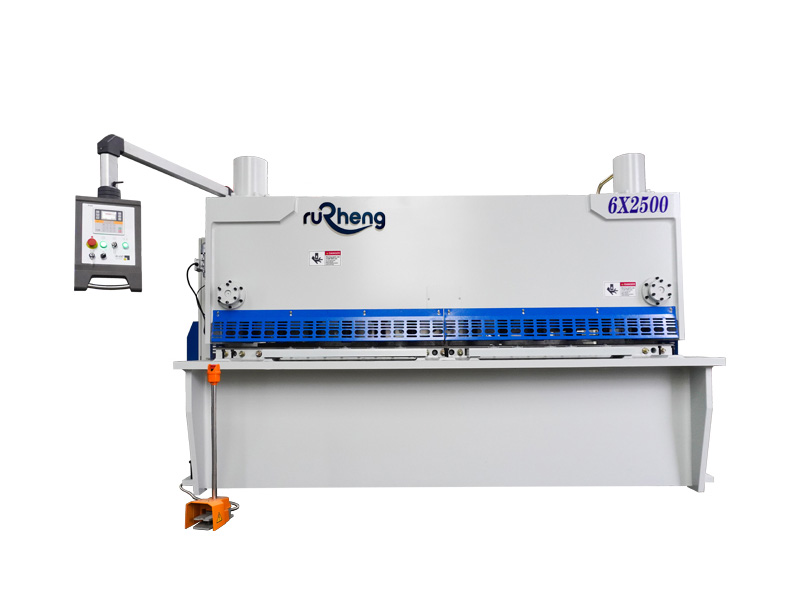
When it comes to cutting sheet metal, the shearing machine is the workhorse of every fabrication shop. It is faster than laser cutting for straight cuts, more economical than plasma, and produces clean edges that often need no secondary finishing. But walk into any machinery showroom and you will immediately face a fundamental question: swing beam or guillotine? These two types of hydraulic shearing machines dominate the market, and choosing the wrong one can mean wasted money, subpar cut quality, or limitations that hold your production back for years.
In this comprehensive guide, we break down the differences between swing beam and guillotine shearing machines — covering mechanics, precision, cost, maintenance, and real-world applications — so you can make a confident purchasing decision. For a broader drive-system decision, pair this page with the hydraulic vs mechanical shearing machine guide.
How Shearing Machines Work: The Basics
Before diving into the comparison, let's establish the fundamentals. All shearing machines operate on the same basic principle:
- A flat metal sheet is placed on the machine table
- A back gauge positions the sheet to the correct cutting length
- Hold-down clamps secure the material
- An upper blade descends against a fixed lower blade, shearing the metal along a straight line
The critical difference between swing beam and guillotine machines lies in how the upper blade moves — and this single mechanical distinction creates a cascade of differences in performance, accuracy, and cost.
What Is a Swing Beam Shearing Machine?
A swing beam shearing machine uses a pivoting (swinging) beam to carry the upper blade. The beam is hinged at the top of the machine frame, and hydraulic cylinders push the beam in an arc-like motion toward the lower blade.
How It Works
Think of it like a door hinge. The blade holder swings downward in a curved path, meeting the fixed lower blade at the cutting point. Because the blade travels in an arc rather than a straight vertical line, the blade gap (clearance between upper and lower blades) changes slightly across the cutting length.
Key Characteristics
- Simpler mechanical design — fewer components, easier to manufacture
- Lower purchase cost — typically 20–40% less expensive than equivalent guillotine models
- Arc-shaped blade path — blade clearance is not perfectly uniform across the full width
- Good for general-purpose cutting — mild steel, stainless steel, aluminum in moderate thicknesses
- Easier maintenance — fewer wear parts, simpler hydraulic system
What Is a Guillotine Shearing Machine?
A guillotine shearing machine (also called a variable rake shear or straight-cut shear) uses linear guides to move the upper blade in a straight vertical path. The blade holder travels up and down along precision guide rails on both sides of the machine frame, driven by synchronized hydraulic cylinders.
How It Works
Unlike the swing beam's arc motion, the guillotine blade descends in a perfectly straight line. This means the blade gap remains consistent across the entire cutting width — a critical advantage for precision work.
Key Characteristics
- Linear blade motion — consistent blade clearance across full cutting width
- Higher cutting accuracy — tighter tolerances, less material twist
- Adjustable blade gap — can be fine-tuned for different material types and thicknesses
- Three-point rolling guides — reduce friction and ensure smooth, precise blade travel
- Higher purchase cost — more complex manufacturing and tighter tolerances
- Better for precision work — ideal when cut quality and dimensional accuracy are critical
Head-to-Head Comparison: Swing Beam vs Guillotine
Here is a detailed comparison across the factors that matter most when choosing a shearing machine:
Cutting Accuracy
| Factor | Swing Beam | Guillotine |
|---|---|---|
| Blade path | Arc (curved) | Linear (straight) |
| Blade gap consistency | Varies across width | Uniform across width |
| Typical straightness tolerance | ±0.3–0.5 mm | ±0.1–0.2 mm |
| Material twist/distortion | Moderate | Minimal |
| Repeat accuracy | Good | Excellent |
Cutting Capacity
Both types are available in similar capacity ranges. Common configurations include:
- Width: 2500 mm, 3200 mm, 4000 mm, 6000 mm
- Thickness (mild steel): 6 mm, 8 mm, 10 mm, 12 mm, 16 mm, 20 mm, 25 mm
For the same frame size and hydraulic power, cutting capacity is roughly equivalent. The difference lies not in what they can cut, but in how cleanly they cut it.
Blade Gap Adjustment
This is one of the most significant practical differences:
Swing Beam
Blade gap is typically adjusted manually at the pivot point. Because the blade swings in an arc, the gap varies naturally across the cut width — wider at the ends, tighter in the middle. This limits how precisely you can optimize the gap for different materials.
Guillotine
Blade gap is adjustable independently on both sides and can be set precisely via the CNC controller on modern machines. Some advanced models offer automatic blade gap adjustment that sets the optimal clearance based on material type and thickness.
Why it matters: Incorrect blade gap causes burrs, rough edges, material dragging, and premature blade wear. The guillotine's adjustability means cleaner cuts and longer blade life.
Rake Angle
The rake angle (the angle between the upper blade and the horizontal) determines how the cut progresses across the sheet width. A higher rake angle means the blade contacts less material at once, reducing the required cutting force — but potentially introducing more sheet distortion.
Swing Beam
Rake angle is fixed by the geometry of the pivot mechanism. It cannot be adjusted during operation.
Guillotine
Rake angle is adjustable (hence the name "variable rake shear"). Operators can optimize it for each job: Low rake (0.5°–1°) for more cutting force with minimal sheet distortion — ideal for thin materials or narrow strips. High rake (1.5°–3°) for less cutting force, suitable for thicker materials.
Machine Rigidity and Frame Design
- Swing beam: Typically a welded steel frame with a single pivot point. The frame needs to handle the lateral forces created by the arc motion. Simpler design, but the pivot point is a potential wear area over time.
- Guillotine: Uses a more robust frame with precision-machined guide surfaces on both sides. The three-point or four-point guide system distributes forces evenly. Higher rigidity translates to better accuracy under heavy loads.
Speed and Productivity
Stroke speed is comparable between the two types for similar capacities:
- Light-duty models (6 mm): 20–25 strokes per minute
- Medium-duty (12 mm): 12–16 strokes per minute
- Heavy-duty (20 mm+): 6–10 strokes per minute
The guillotine may have a slight edge in sustained production because its adjustable rake angle allows optimization — lower rake for thin materials means faster cycling with less force.
Purchase Cost
This is where swing beam machines have a clear advantage:
| Capacity | Swing Beam (approx.) | Guillotine (approx.) |
|---|---|---|
| 6×3200 mm | $8,000 – $15,000 | $12,000 – $22,000 |
| 8×3200 mm | $10,000 – $18,000 | $16,000 – $28,000 |
| 12×3200 mm | $15,000 – $25,000 | $25,000 – $40,000 |
| 16×4000 mm | $25,000 – $40,000 | $40,000 – $60,000 |
Prices are approximate and vary by brand, CNC system, and options.
A swing beam machine typically costs 20–40% less than a guillotine of equivalent capacity. For budget-conscious shops or applications where extreme precision is not required, this price difference is significant.
Maintenance and Operating Cost
- Swing beam: Fewer moving parts, simpler hydraulics. The main wear items are the blades and the pivot bushings. Maintenance is straightforward and spare parts are generally less expensive.
- Guillotine: The linear guide system requires periodic lubrication and inspection. Guide wear affects cutting accuracy directly, so maintenance is more critical. However, the adjustable blade gap means you can optimize blade clearance, which actually extends blade life compared to running a swing beam with a suboptimal fixed gap.
Overall maintenance cost: Roughly comparable in the long run. Swing beam has lower parts cost but may need blade replacement sooner due to non-adjustable gap.
When to Choose a Swing Beam Shearing Machine
A swing beam shear is the right choice when:
- Budget is a primary concern — you need reliable cutting at the lowest capital cost
- General fabrication work — cutting blanks, trimming sheets, preparing material for press brake bending or laser cutting
- Moderate precision requirements — tolerance of ±0.3–0.5 mm is acceptable
- Low to medium production volume — not running 24/7 high-volume production
- Thicker materials (12 mm+) — where the slight gap variation has less impact on edge quality
- Simpler operation and maintenance — smaller team, less technical expertise available
Ideal Applications
- Job shops and general fabrication workshops
- Structural steel cutting
- HVAC ductwork and enclosures
- Agricultural equipment manufacturing
- Pre-cutting material before CNC bending or welding
When to Choose a Guillotine Shearing Machine
A guillotine shear is the better investment when:
- Cut quality and precision are critical — parts go directly to assembly or visible applications
- Thin materials and narrow strips — adjustable rake angle prevents twist and distortion
- High-volume production — the machine will run multiple shifts daily
- Diverse material types — frequently switching between mild steel, stainless, aluminum, and alloys (adjustable blade gap optimizes for each)
- Tight tolerances required — ±0.1–0.2 mm straightness across the full cut width
- Long-term investment — the machine will serve your shop for 15–20+ years
Ideal Applications
- Precision sheet metal fabrication
- Automotive and appliance component manufacturing
- Stainless steel and aluminum processing
- Electrical panel and enclosure production
- Any application feeding material to a CNC press brake where blank accuracy affects bending quality
Common Mistakes to Avoid When Buying a Shearing Machine
Based on years of experience helping customers choose the right equipment, here are the most common purchasing mistakes:
1. Buying Based on Price Alone
The cheapest machine is not always the most economical. A swing beam that cannot hold tolerance may generate scrap rates that quickly erode the initial savings. Consider the total cost of ownership: purchase price + blade costs + scrap rate + downtime.
2. Ignoring Blade Gap Adjustment
Many buyers overlook this feature until they start cutting different materials. If your shop processes a variety of material types and thicknesses, the guillotine's adjustable blade gap will save you significant time and blade costs.
3. Under-Specifying Capacity
Always buy more capacity than you currently need. Industry rule of thumb: spec the machine at 60–70% of its maximum capacity for your most common job. This ensures the machine runs comfortably, lasts longer, and handles occasional heavy jobs.
4. Overlooking the Back Gauge
A quality CNC back gauge is as important as the cutting mechanism itself. Look for:
- Motorized back gauge with ±0.05 mm positioning accuracy
- Multi-step programming capability
- Quick retract function
- Sufficient stroke length for your largest blanks
5. Forgetting About Maintenance Access
Consider how easy it is to change blades, access hydraulic components, and perform routine maintenance. A machine that is difficult to maintain will eventually be neglected — leading to premature wear and costly breakdowns. Read our guide on shearing machine maintenance best practices for more details.
CNC Controls: What to Look For
Modern shearing machines — both swing beam and guillotine — are available with CNC controls that dramatically improve productivity and consistency. Key features to evaluate:
- Back gauge programming: Multi-step positioning, stored programs, recipe management
- Automatic blade gap adjustment (guillotine): CNC sets optimal gap based on entered material parameters
- Stroke adjustment: Automatic optimization of stroke height for faster cycling
- Cut counting and batch management: Automatic stop after programmed number of cuts
- Diagnostics and error reporting: Real-time monitoring of hydraulic pressure, blade position, and system health
- Remote connectivity: Some modern controllers offer remote monitoring and diagnostics
Shearing Machine vs Other Cutting Methods
While this guide focuses on comparing shearing machine types, it is worth briefly considering how shearing compares to other cutting technologies:
| Method | Speed (straight cuts) | Edge Quality | Operating Cost | Capital Cost |
|---|---|---|---|---|
| Shearing | Very Fast | Good (clean, no HAZ) | Very Low | Low–Medium |
| Laser Cutting | Medium | Excellent | Medium–High | High |
| Plasma Cutting | Fast | Fair (HAZ present) | Medium | Medium |
| Waterjet | Slow | Excellent (no HAZ) | High | High |
The bottom line: For straight-line cuts on sheet metal, nothing beats a shearing machine on speed and cost-per-cut. If your workflow involves cutting sheets to size before further processing on a press brake or rolling machine, a shearing machine is the most efficient first step.
For complex shapes, contour cutting, or materials beyond sheet metal capabilities, a fiber laser cutting machine is the better choice.
How to Choose: A Quick Decision Framework
Still not sure which type to pick? Walk through these questions:
1. What is your primary cut tolerance requirement?
±0.5 mm or looser → Swing beam is sufficient. ±0.2 mm or tighter → Go guillotine.
2. Do you frequently cut thin strips (under 50 mm width)?
Yes → Guillotine (adjustable rake prevents twist). No → Either type works.
3. Do you switch between different material types often?
Yes → Guillotine (adjustable blade gap optimizes for each material). No → Swing beam is fine.
4. What is your budget?
Need to minimize capital expenditure → Swing beam. Can invest for long-term returns → Guillotine.
5. What is your production volume?
Low to moderate → Swing beam. High-volume, multi-shift → Guillotine.
Why Choose RUCHENG for Your Shearing Machine?
At Nanjing Rucheng Technology, we manufacture both swing beam shearing machines and guillotine shearing machines, giving us the expertise and objectivity to help you choose the right type for your specific needs.
What sets our shearing machines apart:
- Heavy-duty welded frames stress-relieved for long-term accuracy
- High-quality hydraulic systems from leading component suppliers
- Precision-ground blades made from 6CrW2Si tool steel for extended service life
- CNC back gauge systems with ±0.05 mm positioning accuracy
- Global service network with responsive technical support and readily available spare parts
Whether you are setting up a new fabrication shop or upgrading existing equipment, our engineering team can analyze your cutting requirements and recommend the optimal machine configuration.
Frequently Asked Questions
Q: Can a swing beam shearing machine be upgraded to guillotine performance?
No. The fundamental blade motion mechanism is different and cannot be converted. If you need guillotine-level precision, you need a guillotine machine.
Q: How long do shearing machine blades last?
Blade life depends on material type, thickness, and blade gap setting. Typically, a set of quality blades can handle 10,000–50,000 cuts before requiring re-sharpening. Blades can usually be re-sharpened 3–5 times before replacement. Properly set blade gap (easier on guillotine machines) significantly extends blade life.
Q: What safety features should I look for?
Essential safety features include: light curtain protection, rear safety guard, emergency stop buttons on both sides, foot pedal with protective cover, and CE/ISO certification. Never compromise on safety — it protects your operators and your business.
Q: Is a used shearing machine a good option?
Used machines can offer savings, but inspect carefully: check blade condition, frame alignment (use a precision level), back gauge accuracy, hydraulic system for leaks, and guide wear (guillotine). A well-maintained 10-year-old machine from a reputable brand can still perform excellently.
Q: How do I determine the right cutting capacity for my shop?
List the thickest and widest material you need to cut, then add a 30–40% safety margin. For example, if your thickest regular job is 8 mm mild steel at 2500 mm width, consider a 12×3200 mm machine.
Conclusion
Choosing between a swing beam and guillotine shearing machine comes down to your specific requirements for precision, material variety, production volume, and budget. Both are proven, reliable technologies that have served the sheet metal industry for decades.
- Choose swing beam for cost-effective general-purpose cutting where moderate tolerances are acceptable.
- Choose guillotine for precision cutting, thin materials, diverse material types, and high-volume production.
The best investment is the one that matches your actual production needs — not the cheapest option and not the most expensive one.
Ready to discuss your shearing machine requirements? Contact our team for personalized recommendations and competitive pricing.
Explore Our Shearing Machine Solutions
Rucheng Technology manufactures a full range of hydraulic shearing machines with advanced CNC control systems:
Swing Beam Shearing Machine
Cost-effective hydraulic shearing machines for general-purpose sheet metal cutting
Guillotine Shearing Machine
Precision hydraulic guillotine shears with adjustable blade gap and variable rake angle
Not sure which shearing machine is right for your application? Our engineers can help you evaluate your needs and recommend the perfect solution.
Get a Free Consultation