
A press brake's total tonnage is not the permissible load of a short punch or die. Check the rating of the exact tool, holder and machine together. A rating in kN/m describes force per unit length; converting it to total force requires the manufacturer's loading conditions and a confirmed loaded length.
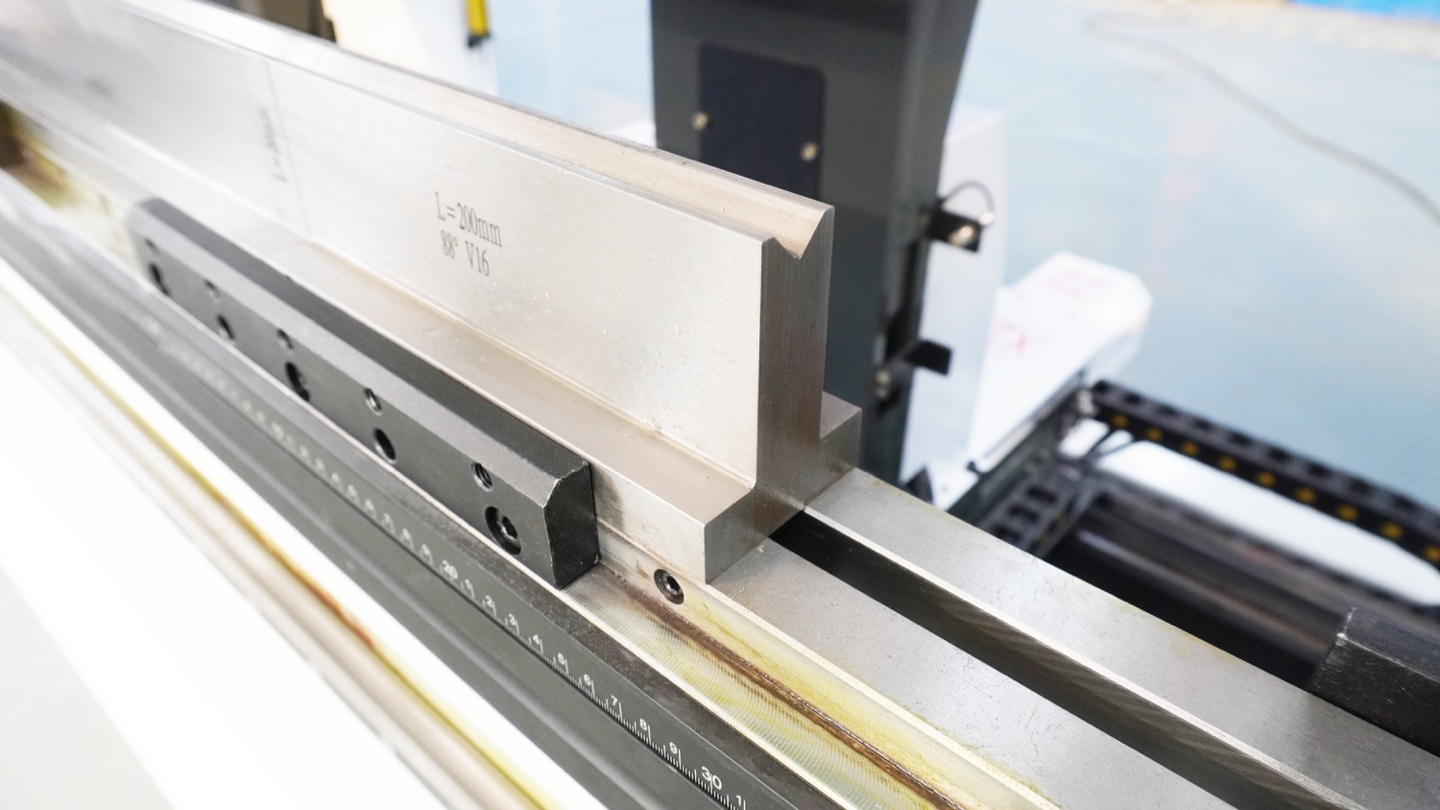
Read the rating before comparing tonnage
Identify the tool profile, segment length, clamping interface and catalogue revision. TRUMPF's tooling manual lists maximum load in kN/m among its tool markings. WILA explains that the converted load must be evenly distributed and that holders or the press brake may be the limiting component. Neither source certifies an unspecified Rucheng configuration.
Worked example: full segments under uniform load
Arithmetic illustration only: assume a documented rating of 800 kN/m, uniform loading across each complete segment and manufacturer approval for that loading arrangement. These are hypothetical values, not ratings of the tools pictured or supplied. Do not use this table for partial contact, horns, gaps, off-center loading or hemming.
Total force (kN) = rating (kN/m) × loaded length (mm) / 1000. Metric tonne-force (tf) = kN / 9.80665. Do not confuse metric tonne-force with US short-ton-force.
| Uniformly loaded segment length | Calculated force | Metric tonne-force, rounded |
|---|---|---|
| 50 mm | 40 kN | 4.08 tf |
| 200 mm | 160 kN | 16.32 tf |
| 500 mm | 400 kN | 40.79 tf |
For a hypothetical 200 mm segment, 800 × 200 / 1000 = 160 kN, about 16.32 tf. A proposed 200 kN demand exceeds that illustrative segment value even on a machine rated above 200 kN. Reject that preliminary setup for supplier review; simply buying a larger press brake does not raise the tool rating.
What to ask the tooling supplier
- Identify the exact punch, die, holders and adapters. Request catalogue numbers, load units, permitted loading conditions and any derating, not only a tooling photograph.
- State material grade, tensile strength if available, measured thickness, bend length, angle, V-opening and forming method. Keep required bending force separate from allowable equipment load.
- Provide the segment layout and part contact length. Ask the supplier to verify the machine's concentrated-load and off-center limits and the weakest component in the complete setup.
- Quote hemming and special profiles separately. Do not transfer an ordinary air-bending calculation to flattening, bottoming or a tool with different geometry.
A supplier-ready capacity record
For each proposed setup, record: part reference; material and thickness; bending method; tool and holder IDs; segment layout; loaded length; required force and its calculation basis; each applicable load limit; supplier approval reference; unresolved exclusions. Attach the record to the quotation so later substitutions can be checked against the same requirements.
This is a purchasing and calculation guide, not an operating procedure or permission to test a tool to its limit. Trained personnel must follow the actual machine and tooling manuals. Missing ratings or an uncertain loading arrangement require manufacturer review before operation.
Questions about tooling load
Can a short tool use the full tonnage of the press brake?
Not from the machine nameplate alone. The short tool, holders and local machine loading limits must all permit the proposed force and loading arrangement.
Is a gooseneck punch rated like a straight punch?
Do not assume equal ratings from appearance or clamping compatibility. Ask for the exact catalogue profile, segment and application limits for each tool.
Request a tooling and machine review
Send Rucheng your machine model, material, thickness, bend length, part drawing and existing tool markings. Ask for an itemized tooling schedule and written capacity confirmation for the proposed configuration.
Send press brake quote requirements