
Choose a press brake clamping system by the tools it must hold, the changes your production schedule requires and the complete changeover time you can actually recover. Manual clamping can suit infrequent changes; powered clamping deserves evaluation when repeated tightening and release consume useful production time. Hydraulic or pneumatic actuation alone does not establish tool compatibility, automatic alignment or safe retention. Compare a documented assembly and an agreed trial, then separate clamp movement from handling, programming and first-piece inspection.
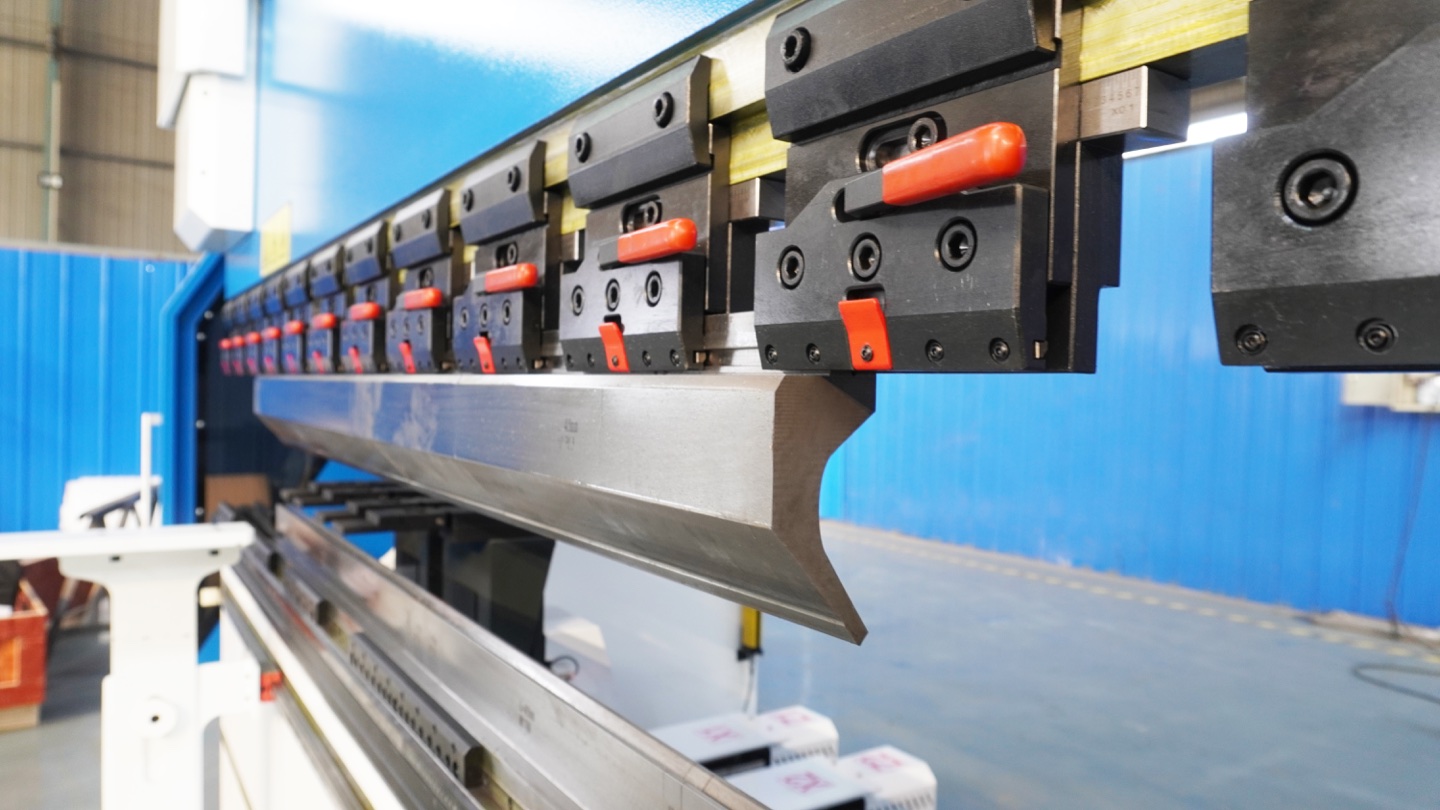
Compare the mechanism and the job it must do
Manual describes operator actuation, not necessarily a slow screw-only arrangement. Wilson Tool lists lever-operated Express Punch Clamps as well as hydraulically powered Express Rail systems. For each proposal, identify the exact holder and approved tool family before comparing the method of actuation.
Manufacturer reference: Wilson Tool.
| Clamping option | Reason to evaluate it | Question for the supplier |
|---|---|---|
| Manual or mechanical | Few tool changes, or a measured changeover in which clamping is a small part of the delay. | Which plates or levers need operation, and how are the tools seated, aligned and retained? |
| Hydraulic | Frequent changes where centralized powered actuation could reduce repeated manual work. | What power unit, connections, controls and maintenance are included for this exact assembly? |
| Pneumatic | A powered option to compare where the specified air supply and machine integration are available. | What air conditions and locking mechanism are required, and what behavior is documented if supply is lost? |
Do not treat all powered holders as equivalent. WILA distinguishes its hydraulic force-locked design from its pneumatic Self-Locking design. That is a description of particular WILA systems, not proof that every pneumatic holder stays locked without air or that every hydraulic product behaves identically. Obtain the selected model's documentation; do not create an improvised pressure-loss test.
Manufacturer reference: WILA.
Clamping, seating, retention and tool handling are separate
Ask the proposal to state what happens automatically and what remains an operator task. A powered clamp is not the same purchase as an automatic tool changer. Likewise, an advertised tool-retention feature does not identify every permitted loading direction or handling method. WILA describes self-seating and self-centering for specified New Standard combinations, while its handling options have their own applicability. Request evidence for the actual combination being offered.
Manufacturer reference: WILA.
Keep the upper and lower systems separate in the specification. An upgrade to the upper clamps may leave the lower die holder unchanged. Before accepting a time-saving claim, establish whether it covers both sides, a partial station change or a complete tooling replacement. Include removal to storage and retrieval of the next tool set if those steps stop production.
Measure from the last accepted part to the next accepted part
Use a consistent boundary for a shop comparison: the last acceptable part of job A to the first accepted part of job B, following the approved setup procedure. Record clamp release and tightening separately from tool movement, cleaning and checks, station positioning, program preparation and first-piece inspection. If tasks overlap, use the elapsed timeline rather than adding overlapping stopwatch readings.
Compare the same representative jobs, tool sets, staffing and acceptance criteria. Keep individual observations and unusual delays instead of reporting only the fastest trial. A quicker clamp may be worthwhile, but it cannot recover time spent waiting for missing tools or unresolved drawings. Do not omit required safety or inspection steps to improve the result.
Worked example: recoverable minutes per shift
The following numbers are hypothetical planning inputs, not a Rucheng test or a supplier performance promise. Assume sequential changeover steps, the same part quality and four changes per shift. Only the measured clamping component is assumed to change; all other elapsed work stays at eight minutes per change.
| Elapsed work per change | Before, minutes | Proposed, minutes |
|---|---|---|
| Release and secure the specified tooling | 4 | 1 |
| All remaining changeover work | 8 | 8 |
| Complete changeover | 12 | 9 |
Recovered minutes per shift = changes per shift × (baseline minutes per change − proposed minutes per change).
Here, 4 × (12 − 9) = 12 minutes per shift. The clamping component falls by 75%, but the complete changeover falls by only 25%. At one change per shift the same assumption saves three minutes. Neither result proves additional saleable output: demand, staffing and the next production constraint still matter.
For a financial review, use the installed cost and a locally justified value for recoverable time. Include integration, compatible tooling, training and maintenance in the comparison. If complete changeover time does not decrease, this time-saving model supplies no positive benefit; assess other demonstrated needs separately. Do not convert a catalogue percentage into a guaranteed payback period.
A retrofit quotation needs more than a clamp price
WILA identifies tool types by tang geometry and distinguishes upper from lower interfaces. Reusing tools therefore needs an interface review even if the proposed holder is powered. Keep the existing compatibility guide as the detailed checklist; use the questions below to make the clamping purchase and integration scope clear.
Manufacturer reference: WILA.
| Quotation item | Evidence or decision to record |
|---|---|
| Tools and machine | Machine identity, holder and tool part numbers, approved interfaces, assembled height, working clearance and applicable load conditions. |
| Power and control | Required utilities, supplied power unit or air preparation, controls, integration responsibility and the manufacturer's documented operating and fault procedures. |
| Handling and storage | Permitted loading directions, tool weights, retention features and the approved assistance or storage arrangement for the selected tools. |
| Acceptance and support | Representative changeovers, dimensional acceptance criteria, included training, maintenance instructions, spare-part identification and exclusions. |
Agree a trial before treating the benefit as established
- Freeze the proposed machine, holder, tool and control configuration. Resolve missing compatibility or load evidence before installation or operation.
- Choose representative production transitions, including the tool changes that occur most often and any demanding handling cases. Define the start and finish events in advance.
- Have qualified personnel use the approved procedure and safeguards. Record elapsed changeover, any correction work and the specified first-piece results; a shorter cycle does not waive acceptance checks.
- Compare complete results with the baseline. Record the accepted configuration and unresolved items. A different holder, adapter, tool set or operating arrangement needs review before reusing the conclusion.
Prepare the clamping part of a Rucheng inquiry
Send the current machine information, tooling list and drawings, representative parts, changes per shift and any measured changeover record. Ask Rucheng to itemize the proposed holder, utilities, controls, reused tools and replacement tools. Supply availability and suitability must be confirmed for that configuration; this guide does not establish a standard package or a retrofit offer for every machine.
Send press brake quotation requirementsClamping system questions
Does hydraulic clamping automatically improve bending accuracy?
The actuation label alone cannot establish the result. Check the approved tools, seating and alignment functions, installation and finished-part acceptance criteria. Verify the proposed assembly with representative work rather than transferring a claim from another system.
Is pneumatic clamping only for an electric press brake?
No universal rule follows from the machine drive. WILA offers pneumatic systems for different machine applications, but a particular retrofit still needs its approved interfaces, utility requirements and control integration confirmed.
When is keeping manual clamping reasonable?
Consider retaining it when the existing approved setup meets the production need and measured changes are infrequent or clamping contributes little to the total delay. Compare the full installed scope and actual benefit before upgrading.