
A hydraulic press brake is usually better than a stamping press for sheet metal bending because bending needs controlled force, controlled ram position and continuous feedback, not only a large impact load. A stamping press is excellent for fast blanking, punching and high-volume die work, but a CNC hydraulic press brake can slow down, stop, compensate, synchronize Y1/Y2 cylinders and correct deflection while the bend is happening.
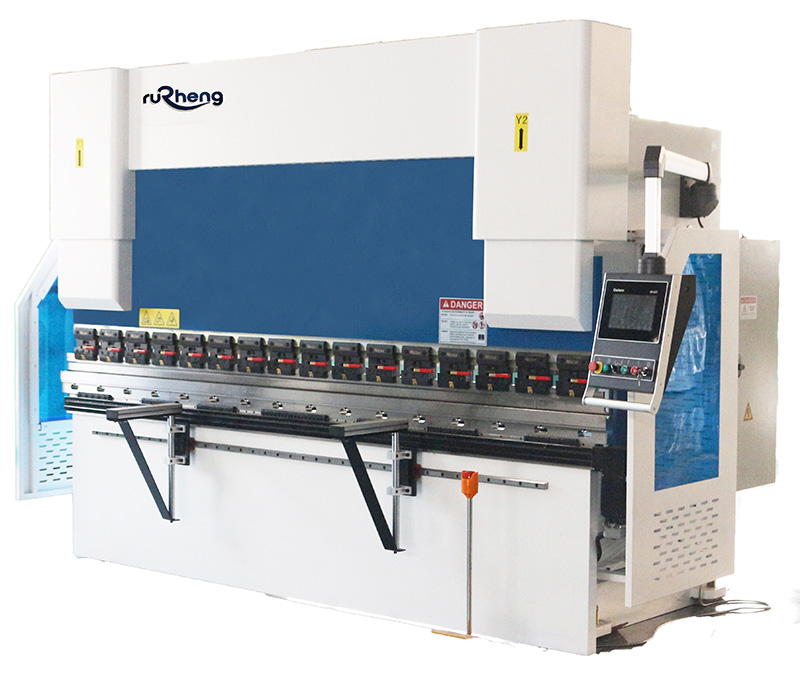
Quick Answer: Why Is a Hydraulic Press Brake Smarter for Bending?
A stamping press applies force through a crank, flywheel or high-speed mechanical stroke. It is built to complete a fixed motion quickly and repeatedly. That makes it productive for punching, stamping and forming in dedicated dies, but less flexible when the job needs angle control, different materials, different bend lengths or small batch changes.
A hydraulic press brake applies force through hydraulic cylinders and controls the ram by pressure, position, speed and feedback. The CNC system can command a slow approach, a bending speed, a target depth, a return position, crowning compensation and back gauge movement. This is why a press brake can make a 90 degree bracket today, a stainless enclosure tomorrow and a long panel after that without building a dedicated stamping die for each part.
What Is the Difference Between a Press Brake and a Stamping Press?
A hydraulic press brake is a sheet metal bending machine. It forms a workpiece between a punch and a V-die, usually by air bending, bottoming or coining. The operator or CNC program controls ram depth, back gauge position, bending sequence, tooling and compensation.
A stamping press is a press machine designed to drive a tool or die through a repeated stroke. It may blank, pierce, draw, emboss or form parts at high speed. In stamping, the die usually defines most of the shape. In press brake bending, the machine position, tool geometry and material springback together define the final angle.
Hydraulic Press Brake vs Stamping Press Comparison
| Factor | Hydraulic Press Brake | Stamping Press | Best Choice |
|---|---|---|---|
| Main job | Flexible bending of sheet and plate with different angles and lengths | High-speed punching, blanking, forming or drawing with dedicated dies | Press brake for flexible bending; stamping press for repeat production |
| Force behavior | Pressure and position can change during the stroke | Stroke is more fixed and impact-driven, especially on mechanical presses | Press brake when controlled force matters |
| Setup cost | Lower tooling cost for many part families | Higher die cost but very fast once the die is built | Depends on batch size and part stability |
| Accuracy method | CNC depth, Y1/Y2 feedback, crowning, back gauge and operator correction | Die precision, press condition, feed accuracy and stroke consistency | Press brake for variable angles and small batches |
| Typical buyer | Fabrication shop, cabinet factory, enclosure maker, job shop | Automotive, appliance, hardware or high-volume stamped part factory | Match the machine to production volume |
Force Is Not the Same as Control
The common mistake is to ask which machine has more force. A stamping press may deliver hundreds of tons through a fast stroke, but bending quality is decided by where the ram stops, how evenly both sides move and how the machine reacts when material resistance changes.
During air bending, metal does not behave like a simple on-off switch. Resistance rises as the punch moves deeper into the die. Stainless steel, high-strength steel, aluminum, galvanized sheet and different material batches all spring back differently. A hydraulic press brake can approach slowly, bend under controlled speed, hold pressure, return, and repeat the same programmed position.
This is the engineering meaning of controlled force: the machine does not simply push harder. It measures, compares and adjusts. For a buyer, this is more valuable than a larger tonnage number when the real requirement is angle consistency over many jobs.
Hydraulic Control: Pascal Law Becomes a Production System
Hydraulic systems use the principle that pressure in a confined fluid is transmitted through the fluid. In a press brake, the pump, valves, cylinders and controller turn that principle into a controlled energy system. The machine can build pressure, release pressure, hold pressure and vary oil flow while the ram moves.
For example, a 3 mm mild steel part may need a moderate force at the beginning of the bend, then a higher force as the angle closes. A CNC hydraulic press brake does not need to use one fixed force from start to finish. It can follow a pressure and position curve that fits the material response.
This is why hydraulic bending feels slower than stamping but often produces better control. The goal is not to hit the metal. The goal is to place the punch at the right depth, with the right speed and the right balance across the full bend length.
Y1/Y2 Synchronization Keeps Long Bends Straight
On an electro-hydraulic CNC press brake, the left and right cylinders are normally controlled as Y1 and Y2 axes. Linear scales measure both sides of the ram, and proportional valves adjust oil flow so the two sides stay synchronized. This matters because a small difference between left and right can create a visible angle error on a long workpiece.
A two-meter or three-meter panel does not forgive poor synchronization. If one side reaches depth earlier, the part can twist, taper or show different angles across the length. Y1/Y2 closed-loop control corrects this by comparing actual ram position with the CNC target many times per second.
This is one of the biggest differences between a modern CNC press brake and a simple impact press. The press brake is not only applying force; it is controlling two moving axes so the force lands evenly along the tool line.
Crowning Compensation Corrects Machine Deflection
Every press brake frame deflects under load. When a long bend is made at high tonnage, the upper beam and lower table can open slightly in the center. Even a fraction of a millimeter can create an under-bent middle section on a three-meter part.
Crowning compensation solves this by adding a controlled counter-deflection in the lower table or tooling support. Manual crowning can work for stable repeated jobs. CNC crowning is better when the shop changes thickness, material and bend length frequently.

A stamping press can also have frame deflection, but its forming result is usually tied to a dedicated die set. A press brake must remain accurate across many tools and many bend lengths, so crowning is a central part of its control system.
Tool Geometry Can Matter More Than Tonnage
Press brake tooling converts hydraulic force into a bend. Punch radius, die angle, V-opening, tool height and clamping accuracy all affect the result. For air bending mild steel, many shops start with a V-die opening about eight times the material thickness, then adjust for short flanges, inside radius, marking risk and material strength.
A narrow V-die increases tonnage demand and may mark the material. A wide V-die lowers tonnage but increases inside radius and may reduce angle control. This means the same machine can behave very differently after a tooling change.
For buyers, tooling should be quoted with the machine. Standard punches, multi-V dies, single-V dies, gooseneck punches, hemming tools, quick clamps and support arms may have more impact on daily productivity than a small difference in machine tonnage.
CNC Control Turns Oil Pressure Into Repeatable Motion
A modern CNC press brake does not simply tell the hydraulic system to provide a tonnage value. It calculates ram depth, bending speed, back gauge position, retract distance, crowning value and bend sequence. The controller then checks feedback from scales and sensors while the ram moves.
This calculation-feedback-adjustment loop is why CNC press brakes are useful in high-mix fabrication. An operator can store programs for cabinets, brackets, door frames, HVAC duct parts and machine covers. When the same part returns later, the setup starts from a proven process instead of a blank screen.
Experienced operators still matter. Oil temperature, material hardness, tooling wear, sheet coating and grain direction can shift the angle. The best result comes from CNC repeatability plus operator judgment, not from software alone.
Hydraulic vs Servo Electric vs Stamping: Which Logic Fits Your Factory?
Servo electric press brakes are fast, efficient and clean because they use electric drive systems instead of hydraulic oil. They are strong choices for thin sheet, small parts, high repeatability and factories that want lower standby energy use.
Hydraulic press brakes remain strong for thicker material, longer parts and broad job-shop work because hydraulic pressure amplification handles changing loads well. Stamping presses remain the productivity leader when the part design is stable and the production volume justifies a dedicated die.
The best equipment choice is not the most advanced name on a brochure. It is the machine whose control logic fits the part mix, batch size, tolerance, labor skill and tooling budget.
Buyer Checklist: When Should You Choose a Hydraulic Press Brake?
Use this checklist before comparing quotes. It turns the control discussion into practical purchasing decisions.
- Choose a hydraulic press brake if you bend many part numbers, small batches or changing drawings.
- Choose electro-hydraulic Y1/Y2 control if long bends, off-center bends or angle consistency are important.
- Specify CNC crowning for long parts, stainless steel, high-strength steel or mixed thickness production.
- Calculate tonnage using material strength, thickness, bend length and V-die opening, then add a realistic safety margin.
- Ask for tooling recommendations, not only the machine price.
- Check throat depth, daylight, stroke and back gauge axes against real drawings.
- Confirm safety devices, installation requirements, training, spare parts and remote support before deposit.
Common Mistakes When Comparing Press Brakes and Stamping Presses
- Assuming the machine with more impact force will automatically bend more accurately.
- Ignoring die cost and setup time when comparing stamping with flexible press brake bending.
- Buying tonnage without checking tooling, V-opening, bend length and material tensile strength.
- Choosing a basic synchronization system for long panels that actually need Y1/Y2 closed-loop control.
- Treating CNC as a replacement for operator skill instead of a system that captures and repeats good process knowledge.
Useful Related Guides
For background physics, see the general explanation of Pascal law. For machine safety planning, OSHA provides guidance on powered press brake guarding and general machine guarding requirements.
For Rucheng selection topics, read our hydraulic press brake machine guide, press brake crowning guide, press brake force calculation guide, press brake tooling guide and electro-hydraulic CNC press brake page.
When the part needs a dedicated die, deep drawing, compression or press fitting instead of flexible bending, compare the four-column hydraulic press product configuration.
Hydraulic Press Brake vs Stamping Press FAQ
Can a stamping press bend sheet metal?
Yes, a stamping press can bend sheet metal when it uses a suitable forming die. It is best for stable, high-volume parts where the die cost is justified. For flexible bending across many angles, lengths and batches, a press brake is usually more practical.
Why is a hydraulic press brake more accurate for small batch bending?
A hydraulic press brake controls ram depth, speed, Y1/Y2 synchronization, back gauge position and crowning. These controls let the machine adjust to different parts without building a dedicated die for each design.
Does higher tonnage mean better bending accuracy?
No. Tonnage is only available force. Accuracy depends on ram position, tooling, material springback, crowning, synchronization, back gauge repeatability and operator setup. Too much force with the wrong tooling can damage parts or tools.
When should I buy a stamping press instead of a press brake?
Buy a stamping press when the part design is stable, the volume is high, cycle time is critical and the budget supports a dedicated die. It can be much faster than press brake bending once the tooling is proven.
Is servo electric better than hydraulic for press brakes?
Servo electric press brakes are efficient and fast for many thin sheet jobs. Hydraulic press brakes remain strong for thick plate, long bends and broad fabrication work. The better choice depends on material range, bend length, tolerance and production mix.
What press brake configuration should a job shop consider?
Many job shops should start by evaluating an electro-hydraulic CNC press brake with Y1/Y2, X/R back gauge axes, CNC crowning, quality tooling and safety guarding. The tonnage and length should be sized from real drawings, not only a catalog average.
Conclusion: The Smart Machine Is the One That Controls Force
The reason a hydraulic press brake often beats a stamping press for bending is not that it is stronger. It is smarter because it can control force, position, synchronization, compensation and tooling interaction during the bend.
If your factory needs flexible sheet metal bending, send Rucheng your drawings, material list, thickness range, bend length and tolerance. Our engineering team can help compare hydraulic press brake, servo electric press brake and stamping options against your real production workflow.
Request Press Brake Selection SupportPress brake selection and production resources
Compare the full Rucheng press brake machine range before choosing tonnage, working length, controller, tooling and automation options.
- Electro-hydraulic CNC press brake for high-mix precision bending.
- Tandem press brake for long parts, poles, panels and structural work.
- Press brake tonnage calculation, tooling selection and controller selection help confirm the final specification.
- For blank preparation before bending, compare fiber laser cutting machines and plan the cutting-to-bending workflow together.