
Choose press brake tool storage from the actual punch and die inventory, the approved support arrangement and the route between storage and machine. A cabinet that has enough room may still have unsuitable holders or insufficient load capacity. Give every tool a traceable identity, location and condition status, then verify it against the setup record before use. This guide explains how to compare cabinets, carts and transfer systems without treating a storage label as approval for bending.
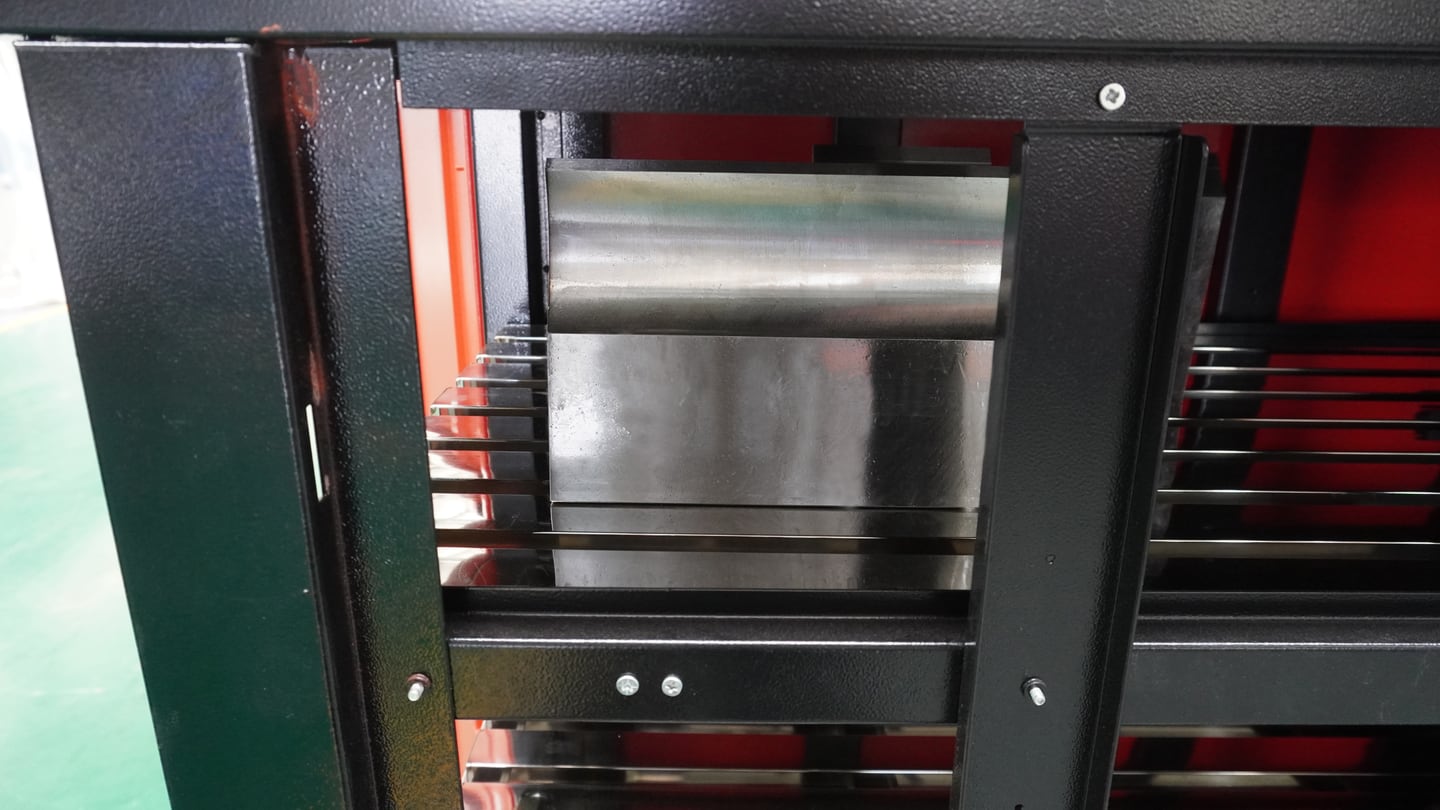
Start with a tool inventory, not the cabinet footprint
List each punch, die, adapter and special segment before comparing storage products. Record the exact supplier reference, interface, section length, overall dimensions, mass and approved storage orientation. Keep the tool drawing or data sheet attached to its identity. A row labelled only as a gooseneck punch can conceal different heights, tip radii, interfaces and load limits.
Count both complete sets and individual pieces. A segmented set can occupy more individual positions than one solid tool of the same total length. Include ear pieces, spare segments and tools awaiting review. Record actual empty positions separately from positions that are reserved for a job or an incomplete set.
WILA describes identifiable tooling near the machine and digital tool data as part of tool management. A local location register can use the same traceability principle without claiming that a barcode makes an unidentified tool compatible.
Source: WILA.
Compare three storage arrangements
Wilson Tool offers both upright and lay-down storage. Neither orientation is automatically correct for every tool. Ask the storage supplier to confirm the insert, support points, available clearance and removal method for your specific inventory. Do not infer compatibility from the cabinet's external dimensions.
Source: Wilson Tool.
| Arrangement | Planning use | Evidence to obtain |
|---|---|---|
| Fixed cabinet near the machine | Frequently used tools assigned to one workstation, with known home positions. | Tool-specific inserts, drawer and cabinet ratings, access envelope and installation requirements. |
| Mobile tool cart | A selected tool kit that moves between an approved storage area and a machine. | Loaded travel arrangement, restraint and parking requirements, floor route and permitted transfer procedure. |
| Integrated storage and transfer system | Tools whose exchange needs an engineered interface between storage and the press brake. | Approved tool/holder combination, transfer height and geometry, load limits and operating instructions. |
ACCURL's published ToolStation description identifies particular WILA holder combinations. That is a useful example of a system-specific interface, not evidence that a similar-looking cabinet or transfer arm fits another press brake. Confirm the complete assembly with its suppliers.
Source: ACCURL.
Keep mass, usable length and position count separate
A storage proposal should report three different quantities: how many pieces it accommodates, how much usable tool length it holds, and the permitted load for each relevant support, drawer, cart or cabinet. Passing one check does not pass the others. Also review the actual load distribution and the manufacturer's installation and stability requirements.
Illustrative inventory only: suppose six tools each have a recorded mass of 8 kg and four smaller segments each have a recorded mass of 3 kg. Their combined tool mass is 60 kg. These assumed masses are arithmetic inputs, not measured specifications for the pictured tools.
Combined tool mass = (6 × 8 kg) + (4 × 3 kg) = 60 kg
The total does not approve putting all ten pieces in one drawer. Map each piece to its actual storage support and confirm how the supplier defines every rating, including any inserts or accessories counted in the load. Tool bending capacity, usually expressed as force or force per length, is a separate limit from storage mass. Neither rating substitutes for the other.
Use a location record that follows the tool
The following is a proposed shop record, not a manufacturer specification. Keep it in a shared register or controlled setup system. A readable label can point to the record; it should not cover a manufacturer's marking or replace the original identity. Decide who updates the record when tools are moved or their condition changes.
| Record field | What to retain |
|---|---|
| Tool identity and revision | Supplier reference, individual ID where available, drawing revision and linked technical data. |
| Geometry and set membership | Profile/interface, section length, relevant dimensions, set ID and required piece count. |
| Home and current location | Cabinet/drawer/position plus the present machine, cart or other approved location. |
| Availability | Available, reserved, in use or held for review; job reference and expected return where applicable. |
| Condition and disposition | Inspection observation, date, responsible role and the authorized decision before reuse. |
For example, a register can show that a punch belongs in cabinet A, position 04, but is currently reserved for job B. A second operator should see the reservation before planning another setup. If a tool returns with an unreadable identity, record the actual location and hold it for review instead of assigning the nearest-looking entry. These are illustrative records, not customer cases.
Check the whole retrieval and return route
Draw the path from the storage position to the machine, including where a cart parks and where a tool is transferred. Review open drawer/door space, handling equipment access and interference with the machine's work area under the site's approved layout and procedures. Keeping tools close is useful only when the location remains suitable for the operation.
Separate locating, collecting, transferring, installing and validating the setup when investigating delays. A faster cabinet search cannot establish the quality of the first bent part. Observe representative jobs before assigning a time saving; do not transfer a supplier's percentage saving to your shop or double-count a saving already attributed to powered clamping.
Make the return decision explicit
- Identify the returning pieces against the job's issued-tool list. Reconcile missing segments, substitutes and any parts still at the machine.
- Use the tooling manufacturer's cleaning, preservation and inspection instructions. Do not introduce a universal chemical, abrasive repair or polishing method from a general storage guide.
- Keep tools with unresolved damage, corrosion or identity concerns outside the available inventory and refer them to the responsible qualified person. A cleaned surface alone does not establish fitness for use.
- Return accepted tools to their approved positions and update location, quantity and status together. Record any unresolved item so the next shift does not mistake an empty position for a complete set.
Connect storage to the next press brake setup
Before installation, compare the retrieved tools with the actual setup record, including the required segment lengths and the approved punch, die and holder combination. Storage helps deliver the right item to that review; it does not replace compatibility, machine/tool load, clearance, safeguarding or first-piece checks.
When discussing a tooling package with Rucheng Machinery, provide the inventory, present storage arrangement, machine/holder details and representative setup changes. Identify which items need storage or transfer support in the proposed scope. Ask for model-specific confirmation instead of assuming that a cabinet, cart or handling system is included with a press brake.
Frequently asked questions
Can one press brake tool cabinet store every tooling style?
Only if the supplier confirms suitable supports, clearances and ratings for each tool family. An empty drawer or a familiar style name does not prove that a particular tool is supported correctly.
Does a tool barcode replace a setup compatibility check?
No. It can identify a record, but the record must match the physical tool and the approved setup. Resolve missing or conflicting tool data before using it.
How should a damaged or unidentified segment be recorded?
Record its actual location and unresolved condition separately from available tools. Keep it out of the issued set until the responsible qualified person resolves the issue under the applicable procedure.